Jaibans Singh

The Anandpur Sahib Resolution (ASR) is best understood as a political and constitutional document, comparable in form and intent to a white paper or a charter of demands. Prepared by the Shiromani Akali Dal (SAD) and formally adopted in 1973, it sought to articulate the party’s long-term vision on a wide range of issues—Sikh religious identity, cultural autonomy, economic justice, agrarian concerns, and, most critically, the nature of Centre–State relations within the Indian Union.
Over the decades, the Resolution has acquired a controversial reputation, often portrayed as a secessionist or quasi-secessionist document. Such interpretations, however, largely stem from later political developments, particularly the militancy of the 1980s, rather than from the original text or intent of the Resolution.
In its conception and early articulation, the Anandpur Sahib Resolution was fundamentally a political response to centralisation, perceived discrimination, and electoral marginalisation, not a declaration of separatism.
Historical and Political Prelude
The creation of Punjabi Suba in 1966 had fulfilled the party’s principal long-standing demand. Yet, the Akali’s struggled to redefine their political narrative. The 1972 electoral rout of the SAD, wherein, the party could win only 24 seats in a House of 117, while the Congress emerged dominant could exposed the fault lines within the party. This defeat was not merely numerical; it represented a deeper crisis of relevance and purpose for the Akali Dal. This situation compelled the leadership to confront a fundamental question: what did the Akali Dal stand for in a post-Punjabi Suba Punjab?
The foregoing was the immediate political trigger of the Anandpur Sahib Resolution and it is in this context that the Anandpur Sahib Resolution must be located. It was not a spontaneous ideological manifesto, but a carefully considered response to political marginalisation.
The SAD needed a fresh, compelling platform that could:
- Reassert its claim as the primary representative of Sikh interests
- Address Punjab-specific economic and agrarian grievances
- Counter the growing centralisation of power under the Congress
- Mobilise its traditional support base, especially farmers
Thus, the Resolution was as much a political survival strategy as it was an ideological statement.
Drafting of the Resolution
On 11 December 1972, the SAD constituted a sub-committee to reflect on the party’s defeat and redefine its platform. The committee comprised senior and influential leaders such as Surjit Singh Barnala, Gurcharan Singh Tohra, and Jiwan Singh Umranangal, among others. These were not fringe figures but mainstream, senior and experienced Akali leaders deeply embedded in constitutional politics.
The committee’s work was methodical. In its first meeting held in Amritsar, it symbolically linked the exercise to Sikh religious and historical consciousness. Subsequent meetings were held in Chandigarh, reflecting the politico-administrative dimension of the exercise. Over the course of ten successive meetings, the committee debated Punjab’s economic condition, centre-state relations, Sikh religious concerns, and the broader federal structure of India.
The final document was unanimously adopted by the SAD Working Committee at Anandpur Sahib on 16–17 October 1973. The choice of Anandpur Sahib, one of the most sacred sites in Sikh history, was deliberate, lending moral and symbolic weight to what was essentially a political document.
Adoption and Political Reaffirmation
Initially, the Anandpur Sahib Resolution did not attract widespread public attention. It remained largely a party document, discussed within political and academic circles. It failed to fulfil its purpose as a mass mobilisation tool. Recognising this, the Akali leadership reaffirmed and publicised it at the 18th All India Akali Conference held at Ludhiana on 28–29 October 1978.
This reaffirmation was significant since, by 1978, the political environment had changed. The Emergency had ended, Indira Gandhi had returned to power, and questions of federalism, civil liberties, and centre-state relations had acquired renewed urgency. The Resolution was now projected as a comprehensive charter of Punjab’s grievances, and gradually it gained traction.
Socio-Political Environment in Punjab
When the Anandpur Sahib Resolution was adopted, Punjab was experiencing a combination of economic stress, political alienation, and cultural anxiety. Given below are the main issues on which Punjab was concerned and apprehensive.
1. Water and River Disputes –The control and allocation of river waters, particularly those of the Sutlej, Beas, and Ravi, was a major source of resentment. The central government retained control over canal head works through the centrally constituted management of the Bhakra Nangal Dam for the Sutlej-Beas waters in the form of the centrally controlled bodies like the Bhakra Beas Management Board (BBMB) which was centrally controlled and managed and continues to be so to date. Despite being a riparian state, Punjab felt disadvantaged by decisions taken by the Centre. The arbitrary allocation frustrated the people of Punjab and fuelled a sense of discrimination on which the SAD built its political agenda.
The Akalis argued that Punjab bore the ecological and social cost of dams and canals, while benefits were disproportionately shared. This sense of injustice was not merely economic; it became emotional and political, reinforcing perceptions of discrimination.
2. Economic Concerns – Punjab had enthusiastically adopted the Green Revolution. The wheat–rice cycle, assured procurement, and Minimum Support Price (MSP) had brought relative prosperity. Yet, the Akali Dal argued that central economic policies were capitalist-oriented, benefiting traders, industrialists, and non-local interests at the expense of Punjab’s agrarian economy. The Resolution repeatedly emphasised the need to protect farmers, ensure fair prices, prevent exploitation by middlemen, and promote agro-based industries within Punjab.
3. Federalism Concerns – A recurring theme of the Resolution was the belief that successive constitutional amendments since Independence of the country had curtailed powers of the state’s and had eroded the spirit of the centre-state relations as perceived by the makers of the Constitution.
This deliberate tinkering with the Constitution on the basis of a huge majority of the ruling party in Parliament had hollowed out India’s federal structure. The Akalis argued that the framers of the Constitution had envisaged a balance between the Centre and the States, which had been steadily undermined in favour of central dominance.
The resolution was an attempt to reverse the situation. It sought greater autonomy for states, and upholding of federal principles. In this respect, the Anandpur Sahib Resolution echoed concerns raised in other states, though it articulated them through the prism of Sikh and Punjabi interests.
4. Religious Concerns – A core motivation for formulation of the resolution was safeguarding Sikh identity and addressing a perceived “discrimination complex” among Sikhs. The overall design was to secure minority interests while demanding recognition for Sikh religious and cultural distinctiveness.
The Resolution as a Political Blueprint
Over time, the Anandpur Sahib Resolution came to be described as the “blueprint” of Akali politics. This characterisation is important. It was not a revolutionary manifesto but a negotiating document, a starting point for dialogue with the Centre.
Its demands ranged across constitutional restructuring, economic justice, minority rights, social welfare, and religious autonomy. The breadth of the document reflected the Akali Dal’s attempt to present itself as a comprehensive political alternative, not merely a sectarian party.
The 1980s: Mobilisation and Misinterpretation
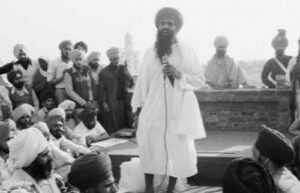
The Resolution acquired national prominence in the early 1980s, particularly after the launch of the Dharam Yudh Morcha in 1982 by the Akali Dal in collaboration with Jarnail Singh Bhindranwale. The Morcha aimed to press for the implementation of the Resolution through peaceful agitation.
Thousands participated, convinced that the Resolution addressed genuine and long-standing grievances like water sharing, Chandigarh, federal autonomy, and religious rights. For many ordinary Punjabis, the document symbolised dignity, fairness, and self-respect.
However, it was also during this period that the Resolution’s ambiguous language became problematic. Phrases intended to argue for autonomy within India were selectively interpreted by extremist elements as justification for separatism. This was less a flaw of intent and more a consequence of rapid political radicalisation.
Secession: Intent versus Interpretation
The Shiromani Akali Dal consistently denied that the Anandpur Sahib Resolution envisaged an independent Sikh state. Sant Harchand Singh Longowal’s statement bears repeating, because repetition here is essential:
“The Sikhs have no designs to get away from India in any manner… What they want is to live within India as Sikhs.”
This clarification was reiterated multiple times by Akali leaders. Yet, once militancy escalated, the Resolution was increasingly viewed through a security lens, both by the Indian state and the wider public. Indira Gandhi and the Congress leadership came to see it as a secessionist charter, regardless of its original framing.
Detailed Identification of Demands
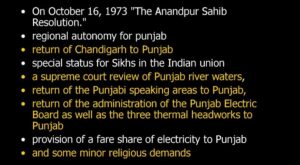
The Resolution articulated twelve major resolutions, which can broadly be categorised as follows:
Federal and Constitutional Demands
- Recasting India into a truly federal structure
- Restricting the Centre’s role to defence, foreign affairs, communications, and currency
- Restoring the balance originally envisaged in the Constitution
Territorial and Linguistic Issues
- Immediate transfer of Chandigarh to Punjab
- Merger of Punjabi-speaking areas
- Second-language status for Punjabi in neighbouring states
Economic and Agrarian Measures
- Revision of Ravi–Beas water awards
- Exemption of agricultural land from wealth and estate taxes
- Establishment of sugar and textile mills
- Abolition of excise duty on tractors
Minority Rights and Social Justice
- Safeguards for religious and linguistic minorities
- Representation for Sikhs in services
- Welfare of Scheduled Castes and backward classes
Religious and Cultural Provisions
- Broadcasting of Gurbani Kirtan from the Golden Temple
- Enactment of an All-India Gurdwara Act
- Standardisation of Gurbani publications
- Revival of Dasvandh
- Free access to Sikh shrines, including those in Pakistan
The Dharam Yudh Morcha
Social and Religious Objectives
A substantial portion of the Resolution dealt with religious revival and institutional reform. These objectives are often overlooked but are central to understanding the document’s character.
The Resolution sought:
- Reinforcement of monotheism
- Training of Sikh youth as missionaries
- Mass initiation into the Khalsa
- Strengthening Sikh intellectual traditions
- Reform and rationalisation of Gurdwara management
- These were inward-looking, reformist goals, not political separatism.
Controversy, Accord and Aftermath
After Operation Blue Star, the Resolution remained the basis for negotiations between the Akalis and the Centre. This culminated in the Rajiv–Longowal Accord of 24 July 1985, which accepted several demands while committing the Akalis to withdraw agitation.
The Accord faced opposition from militants and from sections in Haryana. Longowal’s assassination tragically symbolised how moderate political space had collapsed under extremist pressure.
Concluding Assessment
The Anandpur Sahib Resolution was, at its core, a political bargaining document rooted in constitutionalism and federalism. Its later association with separatism was not inevitable but the product of political breakdown, mistrust, and violence.
To reduce it to a secessionist manifesto is to misread history. Equally, to ignore how it was misused would be to ignore political reality. Its true significance lies in how democratic demands, when left unresolved, can be radicalised by circumstance.
Presently, the Anandpur Sahib Resolution, in its original form, is not an active political programme of SAD or any other party. It is not a part of any official negotiations between Punjab and the Union government. The SAD selectively invokes its federal spirit but does not normally refer to the Resolution as a whole.
Many points raised in the Resolution have been addressed over time, however, an equal number of significant issues like river waters are very much alive and continue to cause concern.
The Anandpur Sahib Resolution is neither implemented nor formally withdrawn. It survives as a symbolic document—important for understanding Punjab’s political history and Centre–State tensions, but inactive as a practical roadmap in contemporary Indian politics.