Dr. Namit Kumar
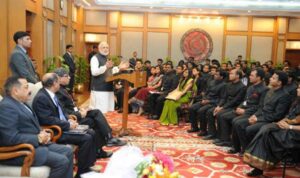
Prime Minsiter Narendra Modi interacting with civil servants during an in-house function
India’s administrative system has long been described as the “steel frame.” Its strength lies in professionalism and neutrality. That strength must be preserved not only in law but also in public perception. Civil servants serve the Constitution. They serve the government of the day. But they do not serve political platforms. Maintaining that distinction is essential for the credibility of governance and the health of democracy.
The recent sight of a serving Director General of Police and a State Chief Secretary sharing a public stage with political leaders has raised serious concerns about judgment and propriety. What was described as an official government function, ended up blurring the line between administration and politics. Whether the event is defended as routine or criticised as a political rally, the fact remains that the presence and speeches of the state’s top civil servants on such a platform send the wrong signal. This goes beyond mere appearance. It suggests a lapse in understanding the legal and constitutional limits that guide the role of senior officers. At a time when public trust in institutions depends on visible neutrality, such behaviour appears to be a significant mistake. Senior civil servants are expected to remain above political platforms, not stand alongside them in ways that can be seen as endorsement.
India’s administrative system is built on the expectation that civil servants remain politically neutral in both conduct and appearance. This principle may not be stated in a single express constitutional provision, but it clearly flows from the scheme of Articles 14 and 16, which demand equality and fairness in state action, and Articles 309–311, which create a professional and secure civil service insulated from partisan pressures. The constitutional design assumes that officers will implement the policies of an elected government with commitment, yet without becoming publicly identified with any political formation. Neutrality, therefore, is not only an ethical value; it is a functional requirement for maintaining public trust in governance.
This expectation is reinforced by statutory conduct rules. Under the All India Services (Conduct) Rules, 1968, Rule 3 requires every member of the service to maintain integrity and conduct consistent with the dignity of public office. Rule 5 prohibits taking part in political activity or associating with political movements. These rules do not only bar formal party membership. They also require officers to avoid public actions that may reasonably be seen as politically aligned. The emphasis is on preserving both actual neutrality and the appearance of neutrality.
The Supreme Court has repeatedly highlighted this principle. In T.S.R. Subramanian v. Union of India (2013), the Court stressed the need for a professional civil service that functions according to law rather than political pressure. It warned that erosion of neutrality weakens governance and institutional credibility. In Prakash Singh v. Union of India (2006), the Court highlighted that the police must operate free from political influence to retain public confidence. Earlier, in State of Punjab v. Ram Singh (1992), the Court held that misconduct in service law includes behaviour that undermines discipline or propriety, even if it is not criminal. Similarly, in Union of India v. J. Ahmed (1979), the Court clarified that failure to maintain standards of conduct expected from a public servant can justify disciplinary action.
Taken together, these constitutional provisions, conduct rules, and judicial pronouncements make one principle clear: senior civil servants must remain visibly detached from partisan platforms. Their authority rests on public confidence that they act for the State as a whole, not for any political interest. When top administrative or police officials appear on overtly political stages, even without explicit endorsement, it risks diluting that confidence and undermining the institutional neutrality that the constitutional scheme seeks to protect.
In practice, senior officers often share platforms with ministers at official programmes. That is a normal part of governance. However, legality depends on context. When a gathering carries strong political messaging, highlights party achievements, or resembles mobilisation of supporters, the presence of serving officers goes beyond routine protocol. It enters a space where conduct rules may be compromised.
The All India Services (Conduct) Rules, 1968 do not only prohibit formal political membership; they also forbid taking part in political activity in any form. Participation in a politically charged event can reasonably be interpreted as indirect involvement in political activity, even without explicit endorsement. Service law recognises that intention alone is not decisive. Public perception matters. When the highest administrative and police officials appear on a political platform, it creates a legitimate apprehension of alignment. That perception itself undermines the principle of neutrality and may amount to a breach of conduct rules.
The Supreme Court has taken a wide view of “misconduct” in service law. In State of Punjab v. Ram Singh (1992), the Court held that misconduct includes behaviour inconsistent with the standards expected of a public servant. It need not involve corruption or criminality. In Union of India v. J. Ahmed (1979), the Court held that failure to maintain proper conduct can justify disciplinary action. The key point is that service discipline includes maintaining institutional propriety and public confidence.
Election law provides further guidance. During election periods, the Model Code of Conduct requires strict neutrality from civil servants. The Election Commission has, in the past, ordered transfers and inquiries when officers appeared partisan. While the present controversy may not fall within an election period, the underlying principle remains relevant. Public confidence in administration depends on visible neutrality at all times.
If a violation of conduct rules is found, disciplinary action can follow under the All India Services (Discipline and Appeal) Rules, 1969. Penalties range from censure and adverse entries to withholding of promotion or other service consequences. The purpose of such action is not excessive punishment but preservation of institutional standards. Even a formal advisory or censure can reaffirm the importance of neutrality.
This does not mean that civil servants must avoid all public platforms with political leaders. Governance requires coordination. Ministers and officers often appear together at official programmes. But prudence is essential. Senior officers must assess whether their participation may be seen as political endorsement. When in doubt, restraint is the safer course.
The recent controversy should therefore be seen as a reminder. It highlights the continuing importance of a neutral civil service. It also shows the need for clearer guidelines on participation of officers in public events that carry political overtones. A quiet reaffirmation of conduct norms would strengthen public trust far more than political confrontation.
India’s administrative system is often called the steel frame. Its strength lies not only in authority but in credibility. Civil servants work with elected governments, but they must remain visibly above partisan politics. Preserving that distinction is not optional. It is a constitutional necessity.
The strength of India’s civil service lies in its credibility. That credibility rests on a simple but vital distinction: civil servants work with elected governments, but they do not publicly align with political platforms. Preserving that distinction is essential for the health of constitutional governance.