Col Iqbal Singh (Retd)
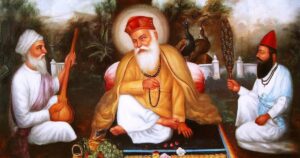
Guru Nanak with Bhai Bala & Bhai Mardana ; The Essence of Sikhi
Sikhism is the philosophy of Guru Nanak, who rejected manmade ritualism and sought to bridge the divide between the two major faiths—Hindu and Islam—that were prevalent in north-western India at the time. His message was universal and inclusive, with humanity as its core mission. He was a man of liberal thoughts, not of radicalised belief. Guru Nanak travelled thousands of miles in all directions, including to the Middle East, the Himalayan regions (often associated with Tibet), and Sri Lanka. Thousands of people, including many Muslims, became his followers.
The succeeding Gurus upheld and defended his doctrine and gradually expanded the faith. The formation of the Khalsa Panth was an extension of this defence and a response to the requirements of the times. Guru Gobind Singh, surrounded by adversaries, had to fight numerous battles with relatively disorganised forces to protect the very existence of the faith. The Khalsa Panth provided a code of conduct and a distinct identity for those willing to defend the faith, but it was neither a rejection of Guru Nanak’s ideology nor of non-Khalsa followers. Guru Gobind Singh’s final message, Guru Manyo Granth, reaffirmed this continuity.
The perplexity today lies in the tension between Guru Nanak’s ideology and the emphasis on identity and the Khalsa. Because of this confusion, custodians of the faith have, in practice, rejected millions of Guru Nanak’s followers, including Sindhi followers in Pakistan. As a result, the community appears to be in decline. Followers of Guru Nanak are being marginalised or discriminated against within the community, leading to mass conversions to Christianity, a drift away from Sikhism, or the search for alternatives such as Radhaswamis, Sacha Sauda, Nirankaris, and other Deras. Even the Gurudwaras in many places or villages are divided based on new distinctions created within the community.
From one perspective, the core reason is that the Sikhism of Guru Nanak has been derailed by its own followers, with Sikhs increasingly deviating from his philosophy. Consequently, the community appears directionless and faces multiple challenges. Manmade rituals are returning. Ten Gurus attempted to reform a segment of society, yet it seems the community is not fully reformed and is gradually moving back to where it began. Beyond identity, one must ask: how are we truly different from others?
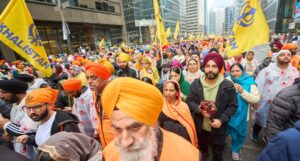
Excessive Public Displays Provoke Unease in Other Communities
Globally, Sikhs constitute a very small minority, and the time may not be far when they become a minority even in the already truncated Punjab, largely due to poor leadership or guidance. Leadership has always been a challenge for the community. Even Guru Gobind Singh Ji, in pursuit of his military mission, had to appoint an outsider—later baptised into the Khalsa—to continue this task.
Recent incidents in New Zealand may be seen as a warning, not only against Sikhs but against Indians in general. A recent Diwali celebration in a Canadian town left the venue littered and in disarray. A similar thing happened when Dushera was celebrated in yet another town. Such behaviour privately angers local communities, who perceive it as uncivilised. In this sense, reactions in New Zealand were not directed solely at Sikhs, but at Indians who failed to respect local values. The flags torn in New Zealand also included Hindu flags and shouted that it is not India.
As a community, it raises an important question: what purpose do Nagar Kirtans serve, especially in Western or developed countries? Excessive public displays of any kind are bound to provoke opposition. Rajneesh, after achieving success in Pune, went to the United States to expand his Osho movement. He was expelled unceremoniously and later died under controversial circumstances. Today, the Osho movement is practically non-existent.
Faith is deeply personal and, particularly in foreign societies, should ideally remain confined to appropriate spaces such as Gurdwaras. The liberal nature of Western societies should not be exploited. Would such activities be possible in China or many Middle Eastern countries?
Buddhism, which also originated in India, spread globally—including in the United States—without creating social friction. Headed by the Dalai Lama, a figure comparable to the Pope, Buddhism benefits from leadership that is spiritually profound, intellectually grounded, globally respected, and attuned to modern realities. Do we have any person or institution of such calibre to guide or lead?
Recently, a friend of mine visited a Gurdwara with his family, and his son was not allowed to enter because he was wearing shorts. Similarly, individuals wearing caps or hats are often denied entry. One must ask what is achieved by such restrictions, especially when the younger generation questions these practices and asks how such attire constitutes disrespect to the faith.
The community needs introspection and must avoid falling into a self-created trap laid by its own members. By returning to and respecting the ideology of Guru Nanak, many of these problems can be resolved. It is time to contemplate. Moreover, the radicalization of this faith has no future.