Col Diptangshu Chaudhury (retd)
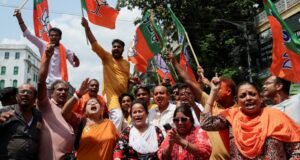
Three successive regimes — British, Nehruvian, *Communist, and then Trinamool — spent a hundred and fifteen years suppressing one of the most productive civilisations the modern world has seen. The BJP now has the first real opportunity to reverse that.
In December 1911, the British announced from the Delhi Durbar that they were moving their imperial capital out of Calcutta because, as Lord Curzon put it candidly to the House of Lords, they wished merely “to escape the somewhat heated atmosphere of Bengal.”
The voters of Bengal have just ended an arrangement that began on that day.
The BJP that now inherits the state must understand that its task is not merely to govern it for the next five years but to play its part in reviving the civilisation that the long arrangement was designed to suppress.
Most educated Indians have been taught for two generations not to look at what that civilisation was. Between roughly 1820 and 1941, a single Indian province produced a body of work whose like was not produced anywhere else in colonised Asia.
It produced the first non-European Nobel laureate in literature; the equation by which modern astrophysics still calculates the temperature of stars; the statistics that govern the behaviour of half the particles in the universe and after which those particles are now named; the first demonstration of millimetre-wave wireless transmission in 1894, two years before Marconi’s celebrated public version; India’s first indigenous pharmaceutical company, founded in a back room with seven hundred rupees of capital.
It produced the religious revival — Ramakrishna, Vivekananda, Aurobindo — that gave nineteenth-century Hinduism the confidence to argue with western Christianity in western languages and not lose. It produced the revolutionaries — from Bagha Jatin to Khudiram Bose to Surya Sen to Subhas Chandra Bose — whose deaths weighed more heavily on British imperial accounting than any number of Gandhian fasts.
It produced Vande Mataram, Jana Gana Mana. And it produced, alongside all this, money. The Bengal Presidency by the 1910s contributed more than half of British India’s overseas trade, and Calcutta operated as the second city of the Empire after London. Calcutta, in Curzon’s honest phrase, had become heated; in plainer language, it had begun to win the argument with the West, and the argument had become inconvenient.
What was done to Bengal between 1911 and 2026 was not natural decline. It was the cumulative work of three regimes, each of which had a structural interest in keeping the place weak. The British recognised in 1911 that they could no longer manage Calcutta and moved their capital out.
The Lutyens-Nehruvian establishment that inherited the British arrangement in 1947 deepened it. The Boundary Commission severed Calcutta from its East Bengal hinterland. Four million Hindu refugees walked westward into a state given no plan for them. Shyama Prasad Mukherjee — who almost single-handedly saved West Bengal from absorption into Pakistan, and whose political party has now returned to govern it — asked Nehru for a Punjab-style population exchange; Nehru declined; Mukherjee resigned in 1950 and died in detention in Srinagar three years later under circumstances the Government of India has never investigated.
Then came freight equalisation, the policy by which the Government of India subsidised the transport of coal and steel and iron ore at uniform national prices and thereby destroyed, by administrative fiat, the locational advantage that had made the Hooghly valley industrial. Bengal’s share of national industrial output collapsed from twenty-seven per cent in 1947 to seventeen per cent by 1961.
The same establishment that had appropriated Vande Mataram and Jana Gana Mana for the Republic proceeded to hollow out the place that had produced them, characterising this asphyxiation, with a straight face, as the natural drift of markets.
The communists who took office in 1977 ran the longest continuous communist government in any democracy in human history. Polite commentary remembers Operation Barga and forgets the rest. The rest includes the Naxalite period, in which an entire generation of Bengal’s most academically gifted young people was destroyed under Charu Majumdar’s doctrine of class annihilation, and the murder of the vice-chancellor of Jadavpur University in his own home by his own students in December 1970.
It includes the Marichjhapi atrocity of January 1979, when several thousand Bengali Hindu Dalit refugees were blockaded on a Sundarbans island, deprived of food and water, and on the thirty-first of January fired upon.
The Information Minister who declared the island “refugee-free” three months later was Buddhadeb Bhattacharjee, who would later become Chief Minister and is to this day fondly remembered in Lutyens drawing-rooms as a cultivated, poetry-loving Marxist. The official death toll is two. There has never been a formal investigation.
The historian Ross Mallick was the first to ask, in print, whether the response would have been the same had the dead been Banerjees and Mukherjees instead of Mondals and Sarkars. The question has not been answered because the answer is known.

The Author: Col Diptangshu Chaudhury (retd)
The Trinamool Congress that took over in 2011 did not reverse the decline but monetised it. Six thousand six hundred and eighty-eight registered companies relocated their head offices out of West Bengal between 2011 and 2025, on the Government of India’s own count tabled in the Rajya Sabha last July, with the destinations of choice being Maharashtra, Delhi, Uttar Pradesh, Chhattisgarh and Gujarat.
There is now a country to the east called Bangladesh, partitioned out of Bengal in 1947, that records a higher per-capita income than West Bengal. The province that produced J.C. Bose has fallen behind the country containing the village he was born in.
These facts are not seriously in dispute. What has been in dispute, until now, is whether they were reversible. I want to argue that they are indeed reversible.
The seventy-five-year stretch between 1947 and 2026 is best understood as an interregnum — a gap between two Renaissances, the first concluded in 1941 with Tagore’s death, the second deferred by three hostile regimes, and now, for the first time in a hundred and fifteen years, structurally unblocked.
You see renaissances across the world do not run on continuous timelines. The Italian Renaissance survived the sack of Rome in 1527, after which Caravaggio came, and Galileo came, and Venetian painting flowered. Renaissances are often interrupted, but rarely killed. What kills them is sustained regime hostility. What revives them is the lifting of that hostility, applied to a civilisational reservoir that has remained intact.
I want to argue that Bengal’s reservoir is intact.
Even under three boots Bengal produced Satyajit Ray, Amartya Sen, Abhijit Banerjee. The diaspora is global and remains, despite five decades of cultural deracination, recognisably Bengali.
The institutions are still standing — Presidency, Jadavpur, Visva-Bharati, IIT Kharagpur, the Indian Statistical Institute, Belur Math, Bose Institute. Visva-Bharati was inscribed as a UNESCO World Heritage Site in 2023. Durga Puja was inscribed on the UNESCO Intangible Heritage list in 2021, the first festival in Asia to receive that recognition. The cultural inventory is world-class. What it has lacked, for three generations, is a state government interested in deploying it.
The BJP’s mandate therefore has two components.
The first is the governance reset, which is necessary and which had better be executed without delay: law and order in the border districts, the syndicate raj broken, the autonomy of the universities restored against political-cadre appointments, the Tajpur deep-sea port actually built after fifteen years of theatre, the Siliguri Corridor secured, the seminar room at R.G. Kar Medical College made safe for the women who study there.
None of this is glamorous. All of it is the precondition for the second component, which is the cultural reset — the work no Indian state government has hitherto seriously attempted.
This cultural revival involves treating Bengal’s universities as universities rather than as patronage networks with hostels attached; deploying Visva-Bharati and Belur Math and Bose Institute as the civilisational generators their founders intended; recovering Subhas Chandra Bose, Vivekananda and Aurobindo from the dismissive custody of the secular consensus; and above all, making it possible for an ambitious young Bengali to imagine a future in Calcutta that does not require leaving Calcutta.
The polite commentariat that said the BJP could not win West Bengal will now say that the BJP cannot do this either. It will be wrong about that for the same reason it was wrong about the first thing: it has stopped looking at Bengal and started looking at its own assumptions about Bengal.
The arc of decline that began at the Delhi Durbar in 1911 was a single arc, executed by three different sets of hands but unified in its structural intention to keep Bengal weak; and several generations of Bengalis have looked at it long enough to be done with it.
What comes next is up to them, and to the government they have just elected — a government whose responsibility is not merely to govern a difficult state for the next five years but to play its part in restoring the civilisation that the long arrangement was designed to suppress.
Bengal has the reservoir. It has, for the first time in a century and more, the political conditions. The rest is a question of nerve.
I am sure BJP with RSS at the helm will ensure the resurgence of West Bengal both socially and politically which will ultimately give a thrust to overall strength of the nation.
A strong leadership, strong policy and strong able administration will ensure Bengal to regain its glory.