Col. Iqbal Singh
Ever since Partition, we as a people, in the twin domains of state and community, have repeatedly positioned ourselves as victims. However, before accepting that narrative, it is important to reflect on the historical context. The partition of 1947 was beyond our control but the partition of 1966 was our own doing. To truly understand where we stand today, we must look back not just decades, but centuries.
It was in the era when Babar invaded India that Guru Nanak, was born into a Hindu family. He emerged as a reformer and spiritual guide for the people of the region. His mission was not tied to any single community, rather, he sought to liberate people from man-made irrational rituals and divisions. He preached the fundamental truth that there is one Creator. He propagated that distinctions and discriminations based on caste, religion, gender, and identity were man-made constructs and he opposed them. He believed in bridging the interfaith gap between two prominent religions, Hinduism and Islam.
In those days when the means of transportation were severely restricted, Guru Nanak travelled thousands of miles in all directions across South Asia, the Middle East, Tibet, and beyond, spreading a message of unity, compassion, and equality. Guru Nanak’s message was not confined to Punjab; his footprint extended across West Asia, the Himalayas, and throughout the Indian subcontinent. His purpose was spiritual upliftment, not territorial conquest. His objective was to reform society.
Because of this, his followers came from all backgrounds—Hindus, Muslims, Tribals, and others who resonated with his universal teachings. Even today, many Sindhis in Pakistan revere him deeply. The same is the case for Tribals in certain pockets within India where he visited. Over time, this community, the followers of Guru Nanak, came to be known as Sikh.
The nine Gurus strengthened and expanded the message of Guru Nanak. Guru Gobind Singh’s creation of the Khalsa Panth was a response to the growing persecution faced by the faith of the Nanaks. Creation of Khalsa by him was based on the awareness that the persecution that had started from the times of Guru Arjan Dev will not stop till some strong military action is not taken.
People from all walks of life, mostly Hindus, became Khalsa to uphold the principles of Dharma (justice and righteousness) and to provide security to the downtrodden. The Khalsa kept alive the flame of universal humanism ignited by ignited by Guru Tegh Bahadur through his sacrifice
Before his passing, Guru Gobind Singh appointed Banda Singh Bahadur (formerly a Hindu ascetic) to continue the struggle against tyranny. Banda Singh Bahadur’s leadership was also not sectarian, his army included Sikhs, Hindus, and Muslims thus demonstrating that the struggle against oppression was collective, not religion-based. After defeating Wazir Khan, who was responsible for the execution of the Sahibzadas, Banda Singh Bahadur liberated parts of Punjab. His reign, sadly, was short lived.
Following Banda Singh Bahadur’s martyrdom in 1716, the Sikh Misls emerged as decentralized military groups providing military leadership that not only defended the region but also evicted the foreign rulers and invaders. By 1782, most of the region was liberated under different Misl leaders but not composite.
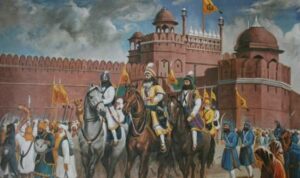
Eventually, Maharaja Ranjit Singh, representing the next generation, united the achievements of these Misls and established an empire that stretched from the Sutlej to the Khyber Pass. His court included Hindus, Sikhs, and Muslims including some Europeans in key military and administrative roles. Whether one calls it the Lahore Darbar or the Khalsa Raj, it was ultimately a Punjabi state, not a religious one but ruled by Sikh commander’s despite being in a minority in the region.
Punjab was once a vast and culturally rich land of the five rivers. But history shows that borders, rulers, and political geography are never permanent; they kept changing. The important point here is this: historically, there was no inherent conflict between Hindus and Sikhs. Leadership was guided by the teachings of Guru Nanak and strengthened by Guru Gobind Singh, not for the benefit of one sect, but for the welfare of the entire region and all people. Punjab belonged to its people, not to any one religious identity.
Given this noble tradition, if today one were to argue about “rightful ownership” of Punjab, who amongst the past rulers would claim it? the British, the Sikhs, the Afghans, the Mughals, Islamic rulers, Alexander, or some others? It is difficulty to give a single concrete answer. The truth is that political control has shifted many times, while the land and its spirit have always belonged to its people.
Today, instead of invoking historical grievances or repeatedly playing the victim card, it may be time to rediscover that universal message of unity and purpose that is an integral teaching of our Gurus and a part of our tradition and ethos.
Many of today’s issues—such as disputes over Chandigarh, water rights, and political fragmentation arose after the reorganization of Punjab in 1966 and repeated agitations, largely under pressure from the Akali leadership. The decades that followed have seen weak, corrupt, and self-serving politics, resulting in decline across multiple sectors—economic, social, industrial, and cultural with multiple agitations that eventually led to militancy in the state. Politically Punjab, with only 13 Lok Sabha seats out of 543 became irrelevant. It could have been 28.
Punjab today does not need nostalgia or anger, it needs renewal. It needs to move forward and not remain in the victim mind-set. It needs capable new non-sectarian leadership that has qualities of integrity and vision. Its leadership will need to unite all communities and people and meet the challenges of the present collectively, rather than exploiting the wounds of the past.
Today’s problems to quite an extent are our own creation. Had there been no division of Punjab in 1966, we would not be facing a lot of the problems that we are facing today. Unfortunately, nothing much can be done to undo this, and solutions now have to be found from within.
Despite the reorganization of Punjab, nothing has been achieved on the front of propagating the Sikh religion, nurturing the Punjabi language, building a future for our youth and remaining at the highest level of growth. We have, on the other hand, achieved a level of unimaginable degradation.
Punjab needs to find ways to move forward and not look back with anger. There are multiple problems. All issues offer resolution if a sincere effort is made. We can address the water issue with the help of technology and creation of modern infrastructure. The opportunities for the youth can come by only if a suitable atmosphere is created in the State to attract industry and investment. The youth need guidance, repeated agitations and violence is doing a lot of damage to the State. The problems have magnified as the youth are less interested in joining the armed forces. Of late the migration approach is failing as the US and Canada are no longer interested in absorbing new intake. Effort has to be made to fill the gap. While there are numerous opportunities, it is the outsiders who are exploiting and not the local youth. Agriculture is not a profitable profession anywhere in the world, and that too with limited land holdings, some alternatives need to be found.
It is time to introspect and promote Punjab, Punjabi, and Punjabiat which is the only way to help mitigate many problems. Agitation on every issue is not a solution. New movements like the ‘Jago Punjab’ have nothing new to offer. They are akin to the Anandpur Sahib Resolution. Is Punjab fighting for itself or the rest of India? Why is it looking for support in what is its internal matter? Punjab needs a new approach, a new narrative, and a new visionary leadership to give direction to Punjab and its people. Past leaders and narratives have failed miserably.