Jaibans Singh
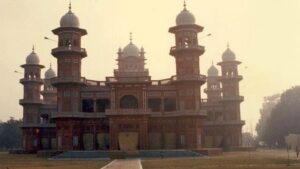
Dera Baba Jaimal Singh, Beas
Punjab is the cradle of one of the oldest civilisations in the world. From the urban sophistication of the Indus Valley Civilization, with major centres such as Harappa and Mohenjo-Daro, to the Vedic and classical ages, the region has witnessed the evolution of complex political systems, enduring social institutions, and enlightened philosophies. Its geography made it both a gateway and a guardian of the Indian subcontinent, shaping its resilient and martial character.
Under Sanatan traditions, society evolved segments that had a distinct role to perform. Of these, the Kshatriyas ruled and administered, while the Brahmins functioned as teachers, philosophers, and moral guides.
Though advisory in nature, the spiritual authority remained distinct from political power. This functional distinction ensured that governance operated within the moral and ethical framework prescribed by Sanatan Dharma. In essence, there existed a civilised balance between temporal authority and spiritual oversight.
Repeated invasions by Central Asian powers, from the 11th century onwards, initiated by Mahmud of Ghazni led to the formation and consolidation of the Delhi Sultanates that altered the political landscape of North India. Punjab, being the frontier province, bore the first and sustained impact of these invasions. Over time, foreign rule became entrenched, eventually transitioning into the Mughal Empire. These centuries brought profound socio-political change, including pressure on indigenous institutions and religious practices.
It was in this atmosphere of political subjugation and social churn that Guru Nanak emerged in the late 15th century as a beacon of spiritual renewal. Rejecting ritualism, caste hierarchy, and empty orthodoxy, he advocated direct communion with the Divine while living an engaged worldly life under the principles of “Naam Jap, Kirat Kar, Vand Chak.” His message resonated deeply with the people of Punjab, cutting across social divisions and restoring dignity and moral clarity. Thus was born the Sikh religion.
Guru Nanak initiated the unique tradition of living Gurus, where the spiritual light (Jot) passed from one Guru to the next. Each Guru built upon the foundation laid by his predecessor, ensuring continuity of vision and adaptability to changing circumstances.
A major milestone in this evolution was the compilation of the Guru Granth Sahib by the fifth Guru, Guru Arjan Dev, in 1604. The original scripture, also called the Adi Granth, included not only the hymns of the first five Gurus but also the spiritually elevating compositions of Bhakts such as Sant Kabir, Sant Ravidas, and Sheikh Farid, representing diverse castes and faith traditions. The construction of Sri Harmandir Sahib as a central shrine, open from all four sides, symbolised this openness. The tolerance to diversity and universal spiritual inclusivity was revolutionary for its time; it endured through the ages and has ever since remained the hallmark of the Punjabi psyche.
The growing consolidation of the Sikh faith caused concern within the Mughal establishment. Guru Arjan’s execution under Emperor Jahangir marked the beginning of systematic persecution.
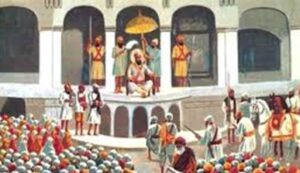
Shri Akal Takht – 1884
In response to these conditions, the sixth master, Guru Hargobind, institutionalised the doctrine of Miri-Piri, the integration of temporal and spiritual authority in the person of the Guru. It was symbolised by wearing of two swords by the Guru and the establishment of the Akal Takht in 1606. This marked the transformation of the Sikh community into a saint-soldier tradition.
The process reached its culmination under Guru Gobind Singh, who in 1699 created the Khalsa at Sri Anandpur Sahib, institutionalising collective identity, discipline, and equality. Before his passing, he vested eternal Guruship in Sri Guru Granth Sahib and the Guru Panth, ending the line of Gurus in person and ensuring doctrinal permanence.
The Sikh community endured severe persecution during the 18th century, including the massacres known as the Chhota and Vadda Ghallughara. Yet resilience prevailed. Through the formation of the Sikh Misls and eventually the establishment of Sikh Empire under Maharaja Ranjit Singh, Sikh sovereignty was realised in the form of Sarkar-e-Khalsa.
Notably, Maharaja Ranjit Singh acknowledged the moral supremacy of the Akal Takht. Historical accounts record instances where Akali Phula Singh, as Jathedar of the Akal Takht, publicly admonished the Maharaja, thus demonstrating the functional application of Miri-Piri.
Punjab was the last major region to fall to the British after the Anglo-Sikh wars (1845–49). It was also among the first to challenge colonial authority, producing revolutionaries, soldiers, and reform movements such as the Singh Sabha and Ghadar movements. The trauma of the 1947 Partition devastated Punjab demographically, culturally, and economically.
Today, the heirs to this ancient civilisation and torch-bearers of Sikh thought are geographically confined to a reduced territory. Decades of economic strain, agrarian distress, environmental degradation, and mounting public debt have weakened the state.
A key concern lies in leadership failure. Corruption, self-serving agendas, blinkered and short-term politics, and erosion of institutional integrity have negatively impacted the fabric of Punjabi society. The Shiromani Gurdwara Parbandhak Committee (SGPC), envisioned as a guardian of Sikh religious institutions and the Akal Takht, historically meant to function as the supreme temporal seat of Sikh authority, are facing allegation of getting played into the hands of a single party and specifically a single family. The situation is such that their autonomy as well as their credibility is at stake. It is felt that they have failed to keep the Panth firmly aligned with the core principles of Gurmat.
The vacuum has enabled the proliferation of Deras. In earlier times the Deras of Punjab were dedicated to the teachings of Sikh Gurus and to Sri Guru Granth Sahib. The Dera head was a devout Sikh who was referred to as a “Sant” due to his piety. He was voluntarily given offerings by his followers in the form of Daswand which he utilised for the welfare of the poor and down trodden. He extended emotional, spiritual and material solace in tune with the tenets of Sikhi.
In the present times while some Deras are pursuing the traditional mode, there are many that are sectarian institutions led by self-proclaimed Godmen who wield tremendous social, economic, and political influence. This proliferation goes against Sikh tenets that look upon Sri Guru Granth Sahib as the eternal living Guru. Most of these new-age Deras involve themselves in political activities by extending electoral support in exchange of patronage.
In a new and worrisome trend these new-age Deras have started building structured political wings along with their religious segment. The method is simple, one eminent member of the Dera conducts forays into the political arena while a different one looks after the so-called spiritual aspects.
The situation has critical manifestations. If Deras start competing for political space, they will cause fragmentation in the Punjabi society of a manner that has not been witnessed in the history of this ancient land. The unity forged through centuries of sacrifice under the guidance of the Guru Granth Sahib may erode. The warning signs are visible.
“Punjab Vasda Guruan De Na Te” (Punjab thrives in the name of the Gurus) remains the enduring philosophy of all Punjabis. This is the spiritual foundation that resurrected the region five centuries ago and restored its dignity. It is a time tested norm that has kept the region and civilisation integrated and strong over centuries. As challenges to the religious consciousness of the Punjabi people based upon Sikhi and the teachings of the Gurus as enshrined in Sri Guru Granth Sahib emerge, it becomes necessary to institute corrective measures that are rooted in traditional customs, the well-established integration of Punjabi society, and moral clarity of the Punjabi people. Above all, the civilisational legacy of Punjab has to be saved from an irreversible decline.