Jaibans Singh
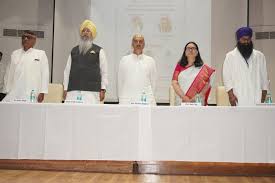
On Monday, 9 March 2026, a group of intellectuals organized a lecture at Panjab University, Chandigarh titled “Sacrifice, Equality and Moral Authority: Sikh History, Guru Tegh Bahadur and the Panj Pyare in the Indian Civilizational Ethos.” The event was intended as an academic reflection on Sikh history and philosophy, particularly the ideals of sacrifice, equality and moral courage embodied in Sikh tradition.
However, some student organizations of the university lodged a protest against the event. What began as a routine expression of dissent quickly spiraled into a controversy that drew attention beyond the University Campus.
The Martyrdom of Guru Tegh Bahadur
Three hundred and fifty years ago, on 24 November 1675, the ninth Sikh Guru, Guru Tegh Bahadur, attained martyrdom in Delhi at the hands of the Mughal regime of Emperor Aurangzeb. His sacrifice occupies a unique place not only in Sikh history but also in the broader history of human rights and freedom of conscience.
Even after three and a half centuries, the martyrdom continues to be commemorated with deep reverence across the Indian subcontinent and worldwide.
Several aspects make this martyrdom exceptional. First, Guru Tegh Bahadur knowingly walked towards his martyrdom, fully aware of the consequences of his defiance against imperial authority. Second, he sacrificed his life to defend the right of Kashmiri Pandits to practice their faith— a faith that he himself did not follow.
Most importantly, the Guru laid down his life for a universal principle — the freedom of belief, speech and expression. In doing so, he established a moral benchmark that transcends religious boundaries and continues to inspire people across faiths and nations.
The 350th anniversary of Guru Tegh Bahadur’s martyrdom has been commemorated by governments, religious institutions, academic bodies and civil society organizations both in India and abroad. Ordinary citizens too have held their own events and participated in other reflecting on the Guru’s life, teachings and sacrifice.
Such commemorations serve as reminders of the values of religious freedom, human dignity and moral courage that Guru Tegh Bahadur embodied. In many ways, this renewed reflection on his legacy is encouraging a wider societal engagement with the ethical foundations of Indian civilization.
The programme at Panjab University was one such initiative aimed at reflecting upon these ideals.
The Speakers and Their Background
The keynote speaker for the event was S. Iqbal Singh Lalpura, who has devoted much of his life to the study and practice of Sikh teachings. He maintains the Prakash of Sri Guru Granth Sahib at his residence and adheres closely to Sikh tenets. His long engagement with Sikh philosophy and history has given him a deep understanding of Sikh thought, making him a relevant voice in discussions concerning Sikh heritage and tradition. He was invited because of his knowledge of Sikh history and philosophy.
The chief guest, Shri Banvir Rana, is associated with the Rashtriya Swayamsevak Sangh (RSS). The RSS has often expressed respect for Sikh traditions, particularly in Punjab, where its gatherings frequently begin with the line from the Sikh Ardas: “Nanak Naam Chardi Kala, Tere Bhane Sarbat Da Bhala.”
The RSS describes itself as a socio-cultural bod. Many of its members across India, particularly in Punjab, express reverence for Guru Nanak, the Sikh Gurus and the teachings of Sri Guru Granth Sahib.
Both the RSS and the Bharatiya Janata Party (BJP) have been organizing programmes across the country to commemorate Guru Tegh Bahadur’s martyrdom anniversary. In that sense, the event at Panjab University was not an isolated initiative but part of a broader series of commemorative activities.
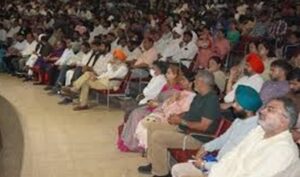
An Elite Audience in a Packed Hall
A Misplaced Protest
Despite the academic intent of the event, around thirty students staged a protest on the day of the lecture. The police briefly took them into preventive custody to maintain order and released them after the programme concluded.
In a democracy, the right to protest is both legitimate and necessary. However, when a protest concerns an event dedicated to the memory of the Sikh Gurus, especially in Punjab, it inevitably invites reflection on the motivations behind such opposition.
The Student Organisations and Their Argument
The protest was primarily led by two student organisations: SATH and the United Sikh Student Federation. Both organizations claim inspiration from Sikh ideology and are relatively new entrants in university politics.
In a memorandum submitted earlier to the university authorities, the organisations cited a 2004 directive issued by a former Jathedar of Sri Akal Takht, the late Joginder Singh Vedanti. The directive had advised Sikh institutions to remain vigilant against attempts to interpret Sikh history through organisations linked with the RSS.
If the concerns are serious enough to warrant restrictions, one would expect a formal prohibition on the public speaking of individuals like S. Iqbal Singh Lalpura by Sikh religious authorities such as Sri Akal Takht. Since no such restriction exists, it is difficult to understand how a small student body could assume the authority to impose a unilateral intellectual embargo.
Denying others the opportunity to speak through pressure tactics hardly aligns with democratic norms. Such an approach risks appearing sectarian rather than principled.
The Question of “Misinterpretation”
Jujhar Singh, founder-president of SATH, justified the protest by alleging that the event represented an attempt by the RSS to “misinterpret Sikh values and history on student campuses.”
This allegation would have held weight only if the speakers had actually made statements that distorted Sikh teachings or history. No such objection of distortion has been raised by any major Sikh religious authority, including the SGPC or Sri Akal Takht.
In the absence of such evidence, the argument of the so-called student union leaders appears to rest on speculation rather than demonstrable facts.
Views of Other Student Groups
Another prominent student organisation on campus, the Akhil Bharatiya Vidyarthi Parishad (ABVP), supported the event. Its leaders maintained that the programme had no political agenda and had been organized by students interested in discussing historical and cultural themes.
They further argued that the RSS respects all religions and that the objective of the programme was to share knowledge about Sikh history and values.
ABVP representatives also suggested that opposition to the event may have been influenced by the upcoming student elections, implying that the controversy had political undertones.
The president of the Panjab University Campus Students Council (PUCSC), Gaurav Veer Sohal, stated that the university authorities had taken necessary measures to maintain harmony on campus. By briefly detaining the protestors, the administration ensured that the event could proceed peacefully.
Sohal emphasized that freedom of expression must remain a fundamental principle of university life.
Visibility Through Controversy
From the sequence of events, it appears that the protest was less about protecting Sikh philosophy and more about gaining visibility in the highly competitive arena of campus politics.
Leveraging the name of a revered Guru for narrow political mileage inevitably leaves an uncomfortable impression. It risks trivializing a profound historical legacy for short-term political attention.
The university authorities have wisely chosen to move past the controversy. Prolonging the issue would only have kept the name of the revered Guru entangled in a political dispute, which would have served little constructive purpose.
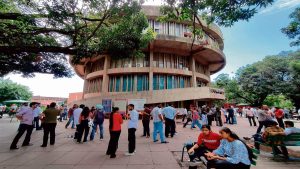
The Changing Nature of Campus Politics
The episode also raises a broader concern regarding the evolving character of student politics at Panjab University. In recent years, the number of student organizations on campus has grown significantly, with more than twenty-five registered groups.
While political participation among students is healthy for democratic engagement, excessive fragmentation often leads to competition for visibility rather than substantive intellectual activity.
There is an increasing perception that the university is becoming more a training ground for future politicians and public performers rather than the cradle of distinguished intellectuals it once was. In earlier decades, Panjab University produced towering figures such as Dr. Manmohan Singh, former Prime Minister of India and one of the country’s most respected economists.
Today, the university’s performance in competitive examinations such as the UPSC Civil Services Examination appears to have declined significantly, raising questions about academic priorities.
Understanding the Essence of Sikh Philosophy
The protest becomes even more puzzling when viewed against the fundamental principles of Sikh philosophy itself.
From the time of Guru Nanak, Sikh thought has encouraged dialogue, rational reflection and engagement with diverse perspectives. The compilation of the Guru Granth Sahib itself is a remarkable example of intellectual inclusiveness, incorporating the spiritual compositions of saints from different regions, castes and religious backgrounds.
The Sikh tradition has historically welcomed people from all walks of life. This openness was vividly demonstrated by Bhai Kanhaiya Ji, who during battle offered water and first aid not only to wounded Sikh soldiers but also to injured enemy combatants.
In this context, opposing a discussion on Guru Tegh Bahadur merely because one of the speakers belongs to a different ideological or institutional background appears inconsistent with the inclusive spirit of Sikh teachings.
A Question of Perspective
Universities are, by definition, spaces where ideas are debated, challenged and refined. It is through open dialogue and intellectual engagement that academic communities grow. Attempting to prevent the holding of a seminar or discussion in such an environment runs contrary to the very spirit of higher education.
Guru Tegh Bahadur sacrificed his life precisely to protect the rights of others to express and practice their beliefs freely. To protest against an event commemorating that very spirit of freedom raises an uncomfortable irony.
Is Sikh philosophy so fragile that it must be shielded from engagement with other traditions? Does the Guru belong only to those who identify as practicing Sikhs?
Guru Nanak’s message was revolutionary, but equally remarkable were the people of his time who possessed the openness to listen, reflect and engage with those ideas.
Conclusion: A Call for Reflection
The controversy at Panjab University should prompt a broader reflection within the Sikh community and among Punjabis at large.
Sikhism is one of the most enlightened spiritual traditions in the world—rooted in universal values of equality, compassion, intellectual openness and fearless defense of human dignity.
It would be unfortunate if, through misunderstanding or intolerance, some groups begin to project the tradition as narrow or exclusionary.
The legacy of Guru Tegh Bahadur calls for courage, moral clarity and openness. Honouring that legacy requires not only remembering his sacrifice but also upholding the values of freedom, dialogue and mutual respect for which he laid down his life.