Jaibans Singh
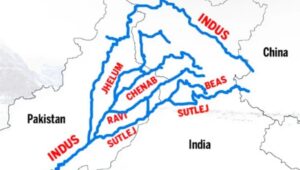
Punjab derives its name from five rivers. Sadly, a big fall-out of the partition was the division of these very holy rivers. This division was carried out between the newly formed nations, India and Pakistan, on the basis of the Indus Water Treaty (IWT). The treaty was signed in Karachi, Sindh, Pakistan by Pandit Jawahar Lal Nehru, then PM of India and Field Marshal Ayub Khan, then President of Pakistan on 19 September 1960. It was duly endorsed by the World Bank. It chalked out the distribution of six major Western Rivers namely Satluj, Beas, Ravi, Chenab, Jhelum and Indus between the two nations.
The treaty gives control of water of three eastern rivers- Satluj, Beas and Ravi to India in a manner that permits building of dams, reservoirs, hydro-power stations, canals, head-works etc. to harness the water and use it for irrigation and drinking purposes. The surplus water can be discharged into Pakistan after giving adequate warning.
The treaty further gives waters of the three western rivers – Indus, Chenab and Jhelum to the two nations with 70 percent going to Pakistan and 30 percent remaining with India. In its 30 percent share, India can utilise the water for navigation, irrigation, fishing but not build any dam or water reservoir. Any structure to control water would require the approval of Pakistan.
DISTRIBUTION OF WATER
With the treaty in place, India laid out plans for optimum utilisation of the waters of Ravi, Beas and Sutlej within the country. Traditionally these waters were being used by the part of Punjab that remained in India and also by Rajasthan.
On 29 January 1955, the states of Punjab, PEPSU and Rajasthan agreed that out of the estimated 15.85 MAF (million acre-feet) available from the three rivers, Punjab would get 5.9 MAF, PEPSU 1.3 MAF, Rajasthan 8 MAF and Jammu and Kashmir 0.65 MAF. With the merger of Punjab and PEPSU in 1956, the total share of Punjab became 7.20 MAF.
Under the Reorganisation of Punjab Act, 1966, a need arose to give a share of the water to Haryana which was being carved out from Punjab as a new state. Haryana claimed 4.8 MAF from 7.2 MAF share of Punjab.
It was an unfair demand right from the word go, one which Punjab had no obligation to meet by any riparian principle. Quite naturally Punjab refused. However, the Congress exhibited a partiality towards Haryana and utilised two opportunities to meet the demand of the state. It first leveraged the situation of emergency in 1976 to implement the Reorganisation of Punjab Act, 1966 and to allocate 3.5 MAF of water to Haryana while Delhi received the remaining 0.2 MAF. Punjab was left with only 3.5 MAF water from its three rivers
In 1980, when Punjab, Haryana and Rajasthan were under Congress rule, the water availability in Punjab rivers was revised from15.85 MAF to 17.17 MAF. Correspondingly, the share of Punjab was increased to 4.22 MAF and that of Rajasthan to 8.6 MAF while Haryana stayed at 3.5 MAF. Hence the Congress led Government, with a smart sleight of hand, ratified the allocation of water to Haryana.
Construction of Sutlej Yamuna Link Canal (SYL)
An offshoot of the aforementioned manipulation by the Congress was signing of a tripartite agreement in 1981 between Punjab, Haryana, and Rajasthan, which ratified the revised water allocations and mandated the construction of the SYL canal within a two-year timeframe to carry Haryana’s share to the state. On 8 April 1982, then Prime Minister Indira Gandhi formally launched the construction of the SYL canal at Kapoori village of Punjab.

The Sutlej Yamuna Link Canal
SYL was conceived as a 214 kms long irrigation canal. 122 km was to run through Punjab and the rest 92 kms was to run through Haryana. At the end point the canal was to join the river Yamuna.
Since its inception in the 1980’s the project has been a point of contention among the two states. The construction of the canal stared in April 1982. While Haryana was quick in constructing its portion of the canal, there was solid opposition in Punjab which led to a massive agitation.
Shiromani Akali Dal (SAD) launched an agitation in 1982 under the leadership of Sant Harchand Singh Longowal. In August 1982, the agitation was converted into a Dharam Yudh and it took a violent turn, plunging the state into chaos.
SAD had also filed a suit against the order of the Union government and demanded adjudication on the issue by the Supreme Court. Again, on 5 November 1985, the Punjab Legislative Assembly, with SAD in majority, repudiated the 1980-81 agreement.
On 24 July 1985, the then Prime Minister Rajiv Gandhi and Harchand Singh Longowal signed the Punjab Accord in New Delhi. One point of the accord was completion of the canal by August 1986. The construction resumed but the work had to be stopped when two senior engineers and 35 labourers working on the canal were shot dead. A decision was taken to rope in the border roads organization, but no progress was recorded.
In 1996 Haryana filed a plea in the Supreme Court, seeking directions for Punjab to complete the canal. The Supreme Court, on January 15, 2002, and later on June 4, 2004, passed orders to Punjab to complete the remaining portion of the canal. All Punjab governments since then have expressed a reservation to implement this order.
In response to the Supreme Court order, on 12 July 2004, the Punjab Legislative Assembly passed the Punjab Termination of Agreements Act, 2004 that sought to terminate the water-sharing agreements with the neighbouring states. In 2016, the Supreme Court started hearings into the Presidential reference (Article 143) to decide on the legality of the 2004 Act and declared that Punjab had backed out of its promise to share the waters of the rivers. Thus, the Punjab Termination of Agreements Act, 2004 was termed as constitutionally invalid.
On 15 March 2016, with Congress in majority and Captain Amarinder Singh as Chief Minister, the Punjab legislative assembly again unanimously passed the Punjab Satluj Yamuna Link Canal Land (Transfer of Proprietary Rights) Bill, 2016, which paved the way for return of the land that had been acquired for building the canal. The government then started the process of de-notification of the land and its return to the original owners. The Supreme Court passed orders to override this process. On 16 November 2016, Punjab Legislative Assembly passed a resolution demanding royalties for river water supplied to its riparian neighbour Haryana, Rajasthan and Delhi.
On 22 February 2017, the Supreme Court ordered the Government of Punjab to abide it’s the court order on construction of SYL canal. It said that it would pass a decree if the Governments of Punjab and Haryana failed to come to an agreement.
The issue took a critical turn due to passing of an order by the Supreme Court on 5 October, 2023 reprimanding the Punjab government for its failure to construct its side of the Sutlej-Yamuna Link (SYL) canal, in accordance with the 21-year-old directive of the court. The apex court has ordered the central government to facilitate a survey of the present condition of the canal in Punjab.
The directive of the Supreme Court ignited a political storm in Punjab. All parties of the state, unanimously opined that Punjab has no water to spare and share with neighbouring states under the present changed conditions.
The dominant feeling in Punjab was that the aforementioned directive of the Supreme Court was the result of a weak presentation of the case by the AAP led government of Punjab, wherein, the state counsels said that the government is ready to reconstruct the canal but the opposition parties and farmer unions are not allowing it to do so. Under pressure from the opposition, the chief minister of Punjab, Bhagwant Mann, on 8 October dared state presidents of the BJP, Congress and SAD to an open debate on the issue and other issues too. Nothing much came out from this political posturing. The matter is still hanging.
THE BHAKRA BEAS MANAGEMENT BOARD (BBMB)
The Bhakra Beas Management Board (BBMB), an ISO 9001 14001 certified board, was established as a joint venture between the then-undivided Punjab and Rajasthan. As a consequence of the Punjab Reorganisation Act, 1966. Its statutory functions got converted into management of the waters of Haryana along with the earlier responsibility of Punjab and Rajasthan. It found legal sanctity from Sections 79 and 80 of the Reorganisation Act.
As a statutory body, BMB’s responsibilities include regulation of water flows of the Bhakra Nangal and Beas projects for power generation and to provide irrigation and drinking water to the states of Punjab, Haryana, Rajasthan, Himachal Pradesh, Delhi, and Chandigarh in accordance with the awards that have been given to each over time.
It is also responsible for operation, maintenance, renovation and modernization of the Hydel projects. It maintains the transmission network, canal systems and exploits new Hydro & Solar Power Potential
At the beginning of the accounting year in August-September, depending on the monsoon, the BBMB determines the amount of water to be allocated to each state.
The board has a chairman assisted by two full-time members. Under the Punjab Reorganisation Act, 1966 and the original arrangement of BBMB, the two full-time positions, member (Power) and member (Irrigation) are to be filled by officers from Punjab and Haryana respectively.

Proposal to Change the Constitution of the Board
The Power Ministry of the Union Government that controls BBMB floated a proposal to increase the number of whole-time members from two to four by adding one representative each from Rajasthan and Himachal Pradesh.
In a notification on 23 February 2022, the Ministry of Power, Government of India amended the rules to remove that state-based quota. The new “all-India” (union-pool) recruitment meant that these posts could be held by officers from any state or even central cadre.
The Union Power Ministry says the proposal is based on requests by the mentioned states for fair representation. It further argues that the Board’s mandate has evolved beyond irrigation and power to include inter-state water management for all beneficiary states.
This has emerged as a point of contention especially in Punjab where the people fell that it will lead to a dilution of Punjab’s stake
Proposal to Expand Eligibility Criteria
Another point of contention in recent years is the central government’s 2022 decision to expand the eligibility criteria for the appointment of BBMB members and the chairman to allow selection from central cadres also. The centre justifies this change on the premise that by having members from across India the board can function more impartially and avoid state-level bias.
Political leaders and intelligentsia in Punjab argue that non-Punjab officers may not understand, or may not prioritise, Punjab’s water/power needs, agricultural demands, canal-irrigation timing, flood-control, sedimentation issues or local rehabilitation concerns. This work requires people who know and understand Punjab’s geography, climate and agriculture patterns. Outsiders may not appreciate or prioritize those concerns.
Punjab claims that allowing central/other-state officers to hold key BBMB positions undermines the federal balance. Some political leaders and parties regard the move as an encroachment on state rights and a “federal erosion.”
Position of the Government of Punjab
The Government of Punjab says that legally the addition of members from Rajasthan and Himachal Pradesh through the proposed amendment to Section 79 (and related sections) of the Punjab Reorganisation Act 1966 would exceed the limits set out in that Act insofar that there cannot be more than two whole-time members.
Punjab contended (e.g. in May 2025) that some BBMB meetings, especially those deciding on extra water release, were called without giving the mandatory seven-day notice under BBMB’s 1976 regulations. Thus, the Union government is attempting to centralize control over BBMB appointments and diluting the traditional exclusive representation of Punjab and Haryana.
Punjab is not willing to accept this dilution since it has more than 58% of the water/power share and bears a bulk of financial and operational responsibility of BBMB. It is openly articulated that a decision of this nature will side-line senior engineers/officials of Punjab leading to decisions affecting Punjab being made without adequate representation or state-specific considerations. As politics took a nasty turn, the government of Punjab openly accused the centre of conspiring to gradually turn BBMB into a central-controlled institution.
Because of these concerns, Punjab has, among other actions, created a separate cadre of about 2,458 posts for persons from Punjab for BBMB deployment. This is meant to ensure that key BBMB jobs meant for Punjab are filled by Punjab residents rather than outsiders.
The matter has reached the courts; the Punjab & Haryana High Court has observed that if any state has grievance over BBMB decisions, the statutory remedy is to represent the dissent through the BBMB Chairman to the central government instead of resorting to unilateral interference.
According to a former BBMB member (power) Ashok Thapar, “Discord between states is not a good sign. There were differences between states earlier also but they were resolved in the confines of the office, and never escalated to this level that politicians would cry hoarse in public. The BBMB, once a symbol of national pride, is being used as a tool to up the political ante.”
THE GROUND REALITY
Successive governments of Punjab have taken the plea in the Supreme Court that there has been no adjudication or scientific assessments of river waters in the state till date. The availability of water in the rivers has also come down from the estimated 17.17 MAF in 1981 to 13.38 MAF in 2013. A fresh tribunal should ascertain this and carry out reallocation of the water resources. For Punjab, sharing of water with any other state is now very difficult since water in 79 % of the area is over exploited.
Haryana is already getting a fair share of its water from Punjab from the Indira Gandhi and the Bhakra Link Canal. As things stand, the total water availability in Haryana is more than that in Punjab.
Water from the SYL will not get new areas under cultivation, it will only add to the availability in Haryana that is already quite high. The SYL alignment is against the lie of the land. It is, therefore, not a good project in terms of engineering and water management. The optimum utilization of the Sharda-Yamuna canal project has to be seen in conjunction with SYL.
A bigger challenge is silt accumulating in the reservoir of Bhakra dam. The dead storage level of the dam is 1,462 feet which, BBMB officials say, is set to increase due to the silt in the reservoir.
CONCLUSION
The reality on ground is that Punjab has no water to give to Haryana or any other state. The state is, in fact, staring in the face of a drought like situation in the near future due to an alarming fall in the water table over the years.
The situation can be reversed to an extent by the build-up of a robust canal irrigation system in Punjab, towards which end, no government had paid any heed.
The Supreme Court should constitute a high level committee of experts to examine the water situation in the whole of North India and carry out a realistic reassessment of the water availability and allocation.
It may be expedient for the court to suggest changes in crop patterns and agriculture practices to save water rather than providing it to Haryana to carry on with the wheat-rice agriculture cycle which is leading to an ecological disaster. The need of the hour is to conserve water, not distribute the same.