Jaibans Singh
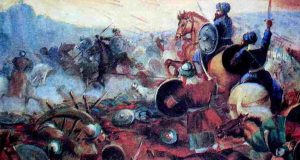
In western history, battles that have changed the course of history are well chronicled. They also form part of the folklore of the country. Two such examples are the Battle of Saratoga in 1777 and the Battle of Waterloo in 1815.
If a similar chronicle of great battles which changed the course of history in India were to be compiled, the Battle of Chamkaur would be given a position of great significance.
The battle was fought over three days from December 21 to 23, 1704 between the Khalsa of Guru Gobind Singh and the coalition forces of the Mughals and Rajput hill chieftains.
In the Battle of Chamkaur, Guru Gobind Singh along with his two sons and forty followers withstood the might of a Muslim and Rajput coalition from a small Haveli (House) which providentially had high mud walls surrounding it. The enemy force comprising of Infantry, horse cavalry and artillery guns was about 1000 strong.
Guru Tegh Bahadur, the father of Guru Gobind Singh, embraced martyrdom on 11 November 1675 for the sake of the Kashmiri Pundit community that was being forcibly converted to Islam by Emperor Aurangzeb. Though of young age, Guru Gobind Singh, on becoming the spiritual leader of his sect, was determined to convert his community into a force that would fight against all forms of evil and oppression. It was in furtherance of this thought that he created the Khalsa on 30 March 1699.
The Khalsa was enjoined to maintain a brotherhood of arms and take decisions collectively to fight the oppressor for the sake of the helpless. Much after Guru Gobind Singh had attained martyrdom, his Khalsa carried on with their symbols which made them distinguishable to the enemy among the population; this made them stand and fight while being ever conscious of the legacy and responsibility that their Guru had bestowed upon them.
Once the Khalsa was formed, it started attracting people in vast numbers. The hill princes got nervous of the rising power and military strength of Guru Gobind Singh and they called upon the Mughals to quell the same.
Accordingly, the joint forces of the Mughals and the hill princes attacked the Sikh forces that were tactically dispersed in five forts. Guru Gobind Singh with a small force and the women and small children of his family was in the fortress of Anandpur Sahib.
The coalition forces could not gain the quick victory that they were looking for and were forced into laying siege on Anandpur Sahib to isolate the Guru from his forces. The Sikhs attacked the invading forces with artillery fire and subjected them to lightning raids in which supplies were seized and terrible casualty inflicted upon the invaders. All attempts to storm the citadel were unsuccessful.
The situation went on for seven long months and the coalition forces started feeling the pressure of stretched logistics and massive losses.
It was at that stage that a proposal of safe passage to the Guru, his family and his followers along with negotiation for peace on honourable terms was sent on the name of Emperor Aurangzeb himself; the other chieftains likewise gave their sacred word. In view of the suffering of women and children and pressure from his mother the Guru agreed to take the safe passage.
Guru Govind Singh with his family came out of Anandpur Sahib Fort on a cold night in December. No sooner were they out in the open they were attacked by enemy forces on the banks of the River Sarsa.
The Sikhs, about 400 strong, fought a rear guard action that has no parallels in the annals of military history and successfully made their Guru cross the River along with his two elder sons Ajit Singh and Jujhar Singh and forty Khalsa. Unfortunately, his mother, Mata Gujri and two younger sons, Zorawar Singh and Fateh Singh got separated. They were later captured by the Governor of Sirhind and the young Sahibzadas (Princes) were interned alive in a brick wall. The Sikhs forming the rear guard perished in the battle.
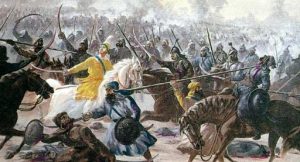
Guru Gobind Singh, his two sons and the forty followers went further and camped in the open at Chamkaur. It was at this stage that two brothers, Chaudhari Roop Chand and Jagat Singh, oblivious of the repercussions from Mughal forces, offered their house in Chamkaur to the Guru and his troops. The house was a mud fortress located on high ground and with high perimeter walls. It had good defence potential. The Guru with his forty Khalsa moved into the fortress and prepared to give a final stand to the enemy forces which were following with a vengeance.
The battle was fought over two days from December 21, 1704. The Guru stayed in Chamkaur for one night. The pursuing force consisted of Infantry, horse cavalry and artillery. The Sikhs rained arrows on the enemy forces. When they started closing in it was decided that small batches of Sikhs would sally forth from the fortress and engage them. These batches stuck terror before falling to a hero’s death and the enemy could not come anywhere near the fortress.
As the battle progressed, the elder son of the Guru, Baba Ajit Singh, requested permission to lead one of the batches. The Guru blessed him and gave permission. Also in this batch was Bhai Mokham Singh, one of the Panj Pyara’s. The group fought fearlessly with some support coming from the fortress. There was havoc in enemy ranks which suffered a terrible loss before the group embraced martyrdom. The Guru, with great pride, watched his son fight to the finish.
The second son of the Guru, Baba Jujhar Singh, barely into his teens, then sought permission to fight the enemy. The Guru gave permission with his blessings. Accompanying Baba Jujhar Singh were two Panj Pyaras, Bhai Himmat Singh and Bhai Sahib Singh, and three more Singhs. This group also caused havoc and cleared an area up to about 35 metres away from the fortress while fighting in a tight circle and killing scores of the enemy. The group also attained martyrdom.
By then the Khalsa force had dwindled to only 11 Singhs but the enemy was in total disarray. The Singhs decided to take advantage of the confusion in the enemy ranks to extricate the Guru. The Guru was not ready to leave his men. It was then that the Singhs invoked the oath of the Khalsa which makes it incumbent for the Guru to heed the advice of five of his disciples. They passed a Gurmat (resolution) directing him to leave the fortress.
Bhai Sangat Singh dressed as the Guru and one more Sikh sallied forth for the last battle to deceive the enemy. In the prevailing confusion, the Guru left the fortress with two Panj Pyaras, Bhai Daya Singh and Bhai Dharam Singh and one more Singh, Bhai Mani Singh. On leaving the fortress, the Guru got onto high ground and blew his horn to tell the enemy that they had been unable to attain their objective of capturing him.
The Battle of Chamkaur laid bare the moral degradation, cowardice and vulnerability of the Mughal imperial forces. The fact that they used deceit to defeat an adversary much weaker in strength indicated their unwillingness to fight with determination. Their inability to attack and overcome even forty Sikhs in a mud fortress pointed towards the inefficiency of the military leadership.
The proclivity of the Mughal rulers to terrorise their subjects into submission and the deceitful nature of the hill chieftains became apparent. It also became quite obvious that when faced with determined opposition the Mughals did not have the will to fight back.
The Khalsa, on the other hand, got converted into an ideologically driven and motivated fighting force of such fearlessness that they eagerly volunteered to follow the path of martyrdom shown to them by their Guru. This always gave to them the upper hand despite all odds of numerical inferiority.
The Battle of Chamkaur, thus, resulted in infusing a strong military ideology among peasants which led to the ultimate downfall of two of the strongest empires (Muslim and Afghan) seen in the history of the world and the creation of a new one – the Sikh Empire.
(Jaibans Singh is a reputed defence expert, columnist, commentator and author)