Col Alok Mathur, SM (retd)

Sutlej Yamuna Link Canal (SYL) is a hydro project that was to connec two major rivers namely Sutlej and Yamuna. It was proposed to originate from eastern side of Sutlej between Nangal Dam and Ropar head-works in Punjab. The point of origin is was to be Village Indupura in District Patiala and terminal point was to be Budeta head-works on western Yamuna canal near Karnal in Haryana. The stated objective was to equally and judiciously distribute water of three rivers of Punjab inherited by Northern Western states after partition of India and help in irrigation of major crops sowed by farmers of Punjab and Haryana belt.
The total length of SYL canal was to be 214 km and was to pass through two states, Punjab and Haryana. The stretch of the canal passing through Punjab would have been 121 kms in length and the stretch of Haryana would have been 93 kms and passing through Karnal and Fatehpur district.
The construction work commenced in 1982 from both states. Haryana completed its share of canal in 1988 but Punjab side it was stalled due to change in State government, politically motivated protests and later due to the threat of militants.
The story goes back to colonial days when United Punjab province was known as land of five rivers. Due to political differences between Congress and the Muslim League, the British decided to partition India in to two separate nations – India and Pakistan. The biggest tragedy was division of the rich and prosperous Punjab province in to East and West Punjab.
Indus Water Treaty between India and Pakistan was signed in 1960 for resolving the River water sharing dispute.
The treaty laid down that that India will utilise 100 percent water of three eastern rivers of Punjab; Ravi, Beas and Sutlej whereas Pakistan was given rights 70 percent rights over Rivers of Indus, Jhelum and Chenab, with the remainder 30 percent remaining with India. The hydrologists had worked out that total water availability in these three rivers that went to Pakistan was 206.6 bcm. Pakistan was allotted 144.6 bcm and Indian share was only 62 bcm. Moreover, no dam was to be constructed on the Rivers Indus, Jhelum and Chenab.
World Bank assisted Pakistan in construction of canal network and India was directed to pay 62 .6 million sterling pounds as aid to Pakistan, which was paid. After Terror attack in Pahalgam in May 2025, IWT has been suspended by India as a retaliatory response.
To work out optimal utility of the water of Rivers Ravi, Beas and Sutlej, a tribunal was formed in 1955 under Union of India with representatives from Jammu Kashmir, Punjab, PEPSU states and Rajasthan for distribution of water of the rivers
Hydrologists laid the total availability of water in Rivers of Ravi, Sutlej and Beas at 19.5 billion cubic metres (bcm) The share allotted to Punjab was 7.3 bcm, Pepsu states 1.6 bcm, Rajasthan 9.9 bcm, and Jammu 0.8 bcm. As PEPSU states were merged in to Punjab in 1956, its share was increased to 7.3 + 1.6 = 8.9 billion cubic metres.
Another review of redistribution of River water had to be undertaken due to Reorganisation of Punjab State which was carried out in 1966. Haryana demanded its share from the 8.9 bcm that had been allotted to Punjab. The Central government finally redistributed it in 1976 as following; Punjab 4.3 bcm, Haryana 4.3 bcm and Delhi 0.3 bcm, with agreement of all stakeholders.
During another Hydrological Report in 1980, it was found that Water availability has increased from 19. 5 bcm to 21.18 bcm. It created need for another refined redistribution of Sutlej Beas Water. Punjab share was increased to 5.2 billion from 4.3 billion. Rajasthan share was also enhanced from 9.9 billion to 10.6 billion. The share of Haryana and Delhi were not changed.
A correct perspective can be drawn only if the canal system of Punjab is reviewed. The state has a vast network of old and new canals spanning over 14,500 km. It serves as backbone of intensive Agriculture activities. Bhakra Dam was constructed in Bhakra village, Bilaspur district of Himachal Pradesh in 1963. Gobind Sagar is a huge water reservoir. 741 feet in height and 1700 feet long. Nagal dam was also commissioned downstream near Village Nangal in Punjab. Bhakra Nangal Dam is the second largest hydrological project in the World and has brought prosperity in states of Himachal and Punjab. It has 5 Turbines producing 1325 MW of power and reservoir capacity of 7.5 million mega litres. The major canals system in Punjab North to South are as listed
- Upper Bari Doab Canal (UBDC) that originates from Madopur head works on River Ravi near Pathankot. It was built in mid-19th century by the British and it had main branches ie Lahore Branch, Khalra branch and Sabraon-Kemkaran-Kasur branch flowing from NE to SW in to Pakistan through Gurdaspur and Amritsar districts covering about 4500 sq km. The canals are still live but have been blocked at IB.
- Bhakra Main Line canal originates from Nangal Dam on River Sutlej and moves down south towards Rajpura and finally links up with tail of Sirhind branch
- Sirhind Canal system originates from Ropar head-works and joins with Patiala branch to finally bifurcate into Abohar branch/Firozpur branch, Bhatinda branch, Kotla branch, Ghaggar branch. It covers almost 5200 sq kms area spread in Ludhiana, Sangrur, Patiala, Nabha, districts of Central and Southern Malwa region of Punjab
- Rajasthan-Sirhind feeder Twin Canal system – Harike Pattan in Punjab is an important Headwork on the confluence of Sutlej and Beas near Makhu town of Punjab. Harike Headwork draws water from Mand Lake and feeds water in to two major canals. Rajasthan Feeder which takes water of Sutlej to deserts of Western Rajasthan, 450 kms away via Rawatsar, Hanumangarh and Birdhwal head near Suratgarh to Pugal, Mohangarh and Ramgarh in Jaisalmer district. Rajasthan Canal, renamed as Indira Gandhi Canal (IGC), is the life line of western deserts of Rajasthan and quench the thirst of millions of people, flora and fauna with sweet and fresh water of Sutlej.
- Gang Canal system – There is another Canal which originates from Hussaniwallah Headworks in Firozpur District on Pakistan border, which feeds Fazilka, Malaut, Ganganagar and Suratgarh region of Rajasthan.
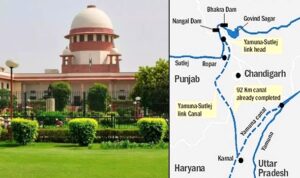
A demand for more water by Haryana and the need to cover villages in the north with the canal system led to initiation of a meeting of all states representatives on 8 April 1982 chaired by PM Mrs Indira Gandhi in the presence of all CMs pf Punjab. Haryana. Rajasthan, Himachal at Kapoori Village, Patiala.
In the meeting, the revised distribution of Sutlej-Beas waters was tentatively agreed upon. CM Punjab, Darbara Singh and CM Haryana, Devi Lal, agreed on the construction, design and alignment of the SYL. The construction commenced in late 1982 from both sides. Haryana’s progress was very fast since Devi Lal immediately allotted Rs. 1 crore for the canal work. As Shiromani Akali Dal returned to power in Punjab in 1985, the construction of SYL in the Punjab side was stalled.
On directions of the Supreme Court, the Ravi Sutlej Beas Water Tribunal was formed under Retd Justice N Balakrishnan Eradi on 2 April 1986. Again, Technical advice of Hydrologists and Engineers was sought. The Tribunal enhanced the water share of Punjab from 5.2 bcm to 6.12 bcm and Haryana also received little increase from 4.3 bcm to 4.7 bcm. Sardar Surjit Singh Barnala was CM Punjab. He approved the proposal and canal work from Punjab side recommenced.
SYL Canal construction work came to stand still between 1985 to 1995 due to rise of terrorism in Punjab. A Chief Engineer of SYL was shot dead by extremists in cold blood, A Superintendent Engineer and about 30 migrant labourers were also killed by militants. There were also local agitations against the construction of the Canal.
Haryana Government has filed a legal suit against Punjab Government as it passed an act in Punjab Assembly regarding ‘Termination of Old Agreements’ in 2004 on Water sharing with Haryana. The Supreme court has criticised the passing of the said Act and declared it null and void. However, the Punjab Government had de-notified all land acquisitions for canal and ordered return of the land to the farmers. There is lot of resentment among farmers as compensation money had been already consumed. The canal is already dug and has become a Nala which cannot be used for cultivation. The Punjab farmers who are in the route of the canal are in favour of its construction.
There was a meeting between two, Bhagwant Singh Mann (CM Punjab) and Nayab Singh Saini (CM Haryana) in Chandigarh in February 2026. The leaders discussed the SYL issue in detail but could not agree to the key points regarding the water sharing. They agreed to take the matter forward through officials and experts. A joint committee of secretary level officials was agreed upon.
The completion of SYL will not only benefit farmers of Haryana but also some farmers of Patiala, Sangrur, Fatehgarh Sahib districts of Punjab. It will irrigate 1.28 lakh hectare of Punjab agricultural land before entering Haryana and generate 50 MW of Power, Haryana will be benefitted by covering 4.46 Lakh hectare for irrigation once canal crosses over to Haryana.
However, Punjab contends that it has no water to give to any other state any more since it is facing acute water shortage compounded with depleting ground water levels. Also, the amount of water available has reduced considerably which calls for a complete reassessment and reallocation in concert with ground position and reality.
A proper fast scientific study needs to be conducted once again to study Punjab’s observation and a timely report submitted so that future negotiations can take place on a realistic platform. The water of the River Yamuna can also be incorporated to ensure optimum utility. in A tunnel link of nine kms from Lingdi River may be considered to boost water availability. It has to be ensured, first of all, that the existing canal networks are being optimally; all points of wastage have to be plugged.
A timely and amicable solution will be beneficial for all stakeholders and is the need of the hour. Most importantly, it should not be allowed to be derailed by petty politics. It should be of a nature that satisfies all parties. The first and foremost thing to understand is that fresh water is fast becoming a scarce resource, it has to be utilised judiciously. There is a need to put in place technology to ensure that not a drop of water is wasted. Then comes the distribution as per basic and unavoidable requirement. Of course, the rights and requirements of the riparian areas have to be given priority.