Col Alok Mathur, SM (Veteran)
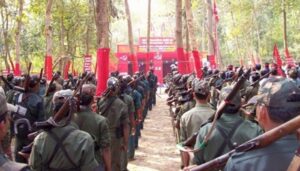
A Naxal Camp in the Forests
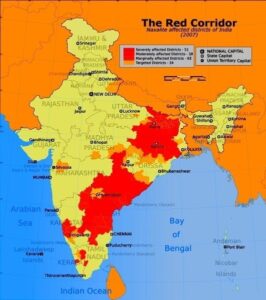
31 March, 2026, was the last sunset in the fortress of the Red corridor. The philosophy of Naxalism, which was conceived in 1967 in West Bengal and infested 12 States of the Indian Union, covering 232 districts ceased to breathe after almost 59 years. It affected almost 1/4th of the entire land mass and 40 crores of the Indian population especially in the remote, thickly forested, isolated tribal region popularly known as the Dandakaranya belt.
Home Minister Amit Shah, during a debate in the Union Parliament, on 30 March 2026, declared that the Government had kept its promise of eliminating the scourge of Left Wing Extremism (LWE). The vow taken by the NDA government in 2014 has now been accomplished.
He stated that Naxalism has been crushed due to an integrated and sustained approach. He paid tributes to brave hearts of the Security Forces (SF), especially the Cobra battalions, CAPF troops, state police personnel, District Reserve Guards and others who made the supreme sacrifice in the line of duty to bring about this huge victory. The Home Minister also paid tribute to the innocent tribals and other civilians, who suffered great agony and lost their near and dear ones during this long and challenging battle. The demon had taken a heavy toll of 25,000 tribals, 1500 plus security forces, government officials and also members of many social institutions and political parties.
Birth and philosophy of Naxalism
Naxalism is a radical left wing communist ideology based on Maoist principles of violence and bloodshed. It originated in 1967, when poor and harassed peasants revolted against the atrocities of rich landlords in village Naxalbari in the Siliguri subdivision of Darjeeling district in West Bengal.
The communist political structure in India emerged post-independence in the form of the Communist Party of India (CPI). The CPI took many new forms due to splits and re-organisations. A new faction CPI (Marxist) came into existence in 1964. Two years later, in 1966, another split brought into the fore the CPML (Marxist Leninist) which was later banned by the Government of India. All communist organisations supported and fuelled the Naxal movement.
Charu Mazumdar, the first urban Naxal to be deeply influenced by Mao Dezong of Red China was the chief architect of the violent Naxal movement. His famous “Historic Eight” documents based on teachings of Marx, Lenin and Mao formed the bible for Naxalism. He advocated revolt against upper class land lords, governments, police and traders who he said exploited the poor. He established people’s court where culprits were to be punished as per tribal laws. His accomplices, Kanu Sanyal and Jangal Sanyal were the chief field commanders.
On 18 May 1967, the Siliguri Kissan Sabha led by Jangal Sanyal declared support to an armed struggle as suggested by Charu and Kanu Sanyal. There was a dispute between landlords and tenants on 20 May. The police party which came to arrest the tenants on the complaint of landlords was ambushed and hacked to death. With the agenda set, Police informers were executed in public and ambushes were laid against security forces. Later, a Maoist Communist Centre was formed, which gave birth to People War Group (PWG) in 1980.
CPM joined Congress in 1971 to form a coalition state government in Bengal. This gave jolt to the Naxal movement. Comrade Satyanarayan Singh revolted against Charu in 1972. The same year Charu was arrested by the Police and during interrogation he died in Alipore jail. The movement was fragmented to a great extent but continued.
The Red Corridor had extended from Pashupati in Nepal to Triupathi in Tamil Nadu. The states that were fully or partially affected included were West Bengal, Jharkhand, Chhattisgarh, Madhya Pradesh, Bihar, Andhra-Pradesh, Telangana, UP, Maharashtra, Tamil Nadu, Kerala and Karnataka.
Initial Anti-Naxal Operations
In July 1971, a low key, joint anti insurgency operation by the Army, Para-military forces and Police was launched against Naxalites in the Red Corridor. Hundreds of insurgents were killed and approximately 20,000 including top leaders were imprisoned. The operation was not disclosed to media. It was prematurely terminated as war clouds were on the horizon and the Indian Army was fully mobilised for the Indo-Pakistan war, 1971.
The Naxal movement, which was suppressed for two decades resurfaced again in late 1990s.To neutralise the growing Naxal activities, “Operation Green Hunt” was launched in 2009 as all-out offensive against the insurgent. 10 CRPF battalions, Indian reserve battalions, Naga police battalions, State Police of different states were deployed. Greyhound special operation group and a flight of MI 17 helicopters was also dedicated. The Maoist suffered approximately 1600 cadres killed and 3000 apprehended. Security forces also incurred loss of 450 troops.
The Maoist response to Operation Green Hunt was deadly. On 15 February,2010, a security forces camp was raided in West Bengal in which 25 policemen were killed. On 6 April, 76 CRPF personnel were ambushed in Dantewada. On 17 May, a bus was blown in an IED blast on Sukma-Dantewada road killing 35 persons. On 29 June, 15 police personnel were hacked at Sukma.
A major untoward incident took place on 25 May 2013 when a Congress rally was attacked in Sukma in Bastar and 29 people were killed, including senior congress leaders Mahendra Karma, Nand Kumar and former CM Vidhyacharan Shukla.
However, due to sustained efforts, the red corridor started thinning and in 2011, the affected districts were reduced to 83 and UP and Karnataka were removed from list.
Anti-Naxal Operations by the NDA Government
The NDA government that took office in 2014 continued the fight against Left Wing Extremis. It suffered considerable set-backs in the initial stages. The major casualties since the NDA government came to power are listed below: –
- On 1 December 2014, 14 CRPF personnel were ambushed in Sukma.
- On 11 March 2017, 15 CRPF personnel were ruthlessly killed in Bastar region and on 24 April the same year again 25 CRP personnel were gunned down near Kala Pather in Sukma district.
- In 2018, a mine protected vehicle was blown by a land mine killing all crew. SF killed 37 Naxals on 22 March, 2018 in retaliatory action.
- In 2019, 15 SF commandos were ambushed at Gadchiroli.
- The year 2020 remained incident free.
- On 23 March 2021, Maoist stuck again and blew up a bus carrying District Reserve Guards with an IED killing five and severely injuring 13 police personnel at Narayanpur district of Chhattisgarh.
Operation Prahar was launched to strike at Naxal camps on special intelligence input on 3 April 2021 in the thick jungle area between Bijapur and Sukma village. It was led by a special Cobra unit. The forces included Central Reserve Police Force (CRPF) Bastaria battalion, along with Special Task Force (STF) of the police and District Reserve Guard (DRG) of Chhattisgarh state police. The force of approximately 2000 troops was subdivided in to five columns of 400 each. They, launched a search and destroy mission from five launch pads namely Tarren, Usroor, Pamed, Minpa and Narsapuram to destroy underground camps of No 1 battalion of People liberation guerrilla army (PLGA) led by Maoist Commander Madvi Hidma.
At 1200 h afternoon, as the leading scouts of Terren column were approaching Village Tekulguda, they were fired upon from three sides. The troops fired back but heavy automatic fire and mortar bombs rained on them. They were trapped in the killing ground. Those who rushed for cover in nearby huts, were attacked by reserve party who stabbed them and cut off their limbs. The command and control was lost. There were approximately 300/400 Naxals fighting the battle who knew the terrain and were seasoned in jungle warfare. The ambush lasted for 2 hours after which the Naxalites withdrew taking with them seven AK 47 Rifles, two 5.56mm INSAS Rifles, and one Light machinegun (LMG). 23 security forces troops were killed ruthlessly, one was missing, and 33 men were severely injured with gunshot and axe wounds. Only one dead body of a woman Naxalite was recovered. It was one of the deadliest ambush in Bastar region after Dantewada ambush of 6 April 2010 in which 76 CRPF personnel were martyred.
A Review of the Anti-Naxal Policy
The Central Government decided to review its policy in New Delhi and pledged to take strict action against Red Terror and set the dead line as 31 March 2026 for its complete elimination. It fine-tuned the multi-prong integrated approach with more volume and push to infrastructure development, winning of hearts of the Tribals and ruthless action against the extremists. It announced an attractive surrender policy and incorporated all affected state governments. A massive action was planned in a coordinated meeting with all affected state governments.
Operation Black Forest was a massive and determined 21 days long operation launched in Karreguttalu Hills located on the borders of Chhattisgarh and Telangana states. The terrain is hilly and covered with thick forest. There are caves and dens which give good concealment and overhead cover. The Indravati River flows through the Karreguttalu forest ensuring a continuous sweet water supply. All these aspects were to the advantage of the Naxals.
Intelligence Reports had confirmed presence of about 100/ 120 Naxalites in the general area and also presence of top leaders of PGLA Battalion. The operation was launched on 21 April 2025 first light and terminated on 11 May 2025. Once again the troops were a mix of CRPF Cobra battalions, Special Task Force of state Police of both States and District Reserve Guards. The total strength of SF was about 10,000. A Flight of MI 17 was also made available for movement of troops, logistics and casualty evacuation. The area was large – about 60 kms long and about 20 kms wide. The weather was extreme summer conditions with temperature in day time reaching about 40 Celsius with high humidity. Director General CRPF, Gyandera Pratap Singh was monitoring the operation constantly.
The strike force initially established forward operating bases. A firm base with adequate reserves was established and search and destroy missions launched. The insurgents divided themselves in to smaller groups and dispersed as they got information from over ground workers. The security forces followed them in strong teams and engaged them. About 33 hide outs were located and destroyed. It is estimated that fatalities of Naxals were about 40 cadres including 15 women cadres. Large quantity of weapons, ammunition, explosives, rations and war like stores were recovered. 450 IEDs of different types were also found.
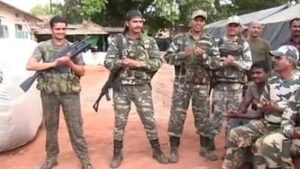
Women Para-military Commandos in Anti-Naxal Operations
On 21 May 2025 in a prolonged encounter based on reliable intelligence input, security forces comprising a DRG special team killed 27 Maoists in Lekawada forest near Boter Village, Narayanpur Tehsil, in Chhattisgarh. CPI(Maoist) chief, Nambala Keshav Rao @ Basvaraju, the mastermind of some of the deadliest attacks, was killed. 26 more hard core cadres accompanying him were also killed. The 70-year-old Basvaraju was a senior leader of CPI (Maoist) since 2004. He was born in Srianakulam District in Andhra Pradesh in 1955 and held a B-Tech degree from REC, Warangal. He was part of the decision making bodies of the Politburo and head of the Central Military Commission. He had masterminded the 2003 assassination attempt on CM Chandrababu Naidu, the ambush on a CRPF convoy in 2010 that killed 75 troops and another ambush on 2013 that claimed 25 lives including top congress leaders. He carried a bounty of Rs.10 crores as declared by NIA. The Union Home Minister named him as backbone of the Naxal movement. His elimination speeded up the process of elimination of Naxalism.
On 3 October 2025, in another big encounter, 38 Maoists including top leadership were killed and a large amount of weapons and ammunition was recovered. The operation was conducted on the tri-junction of Chhattisgarh, Telangana and Andhra Pradesh in Sukma forest.
On 22 November, 2025, another 11 Maoists were eliminated including Madkam Masa who was commander of the south Bastar division and his junior commanders Lakhma Madvi, Doodhi Humgi, Madkam Jeetu, Kosi and Kovasi.
Bastar Range IG P Sunderajan disclosed that during 2025, the pro-active approach of the security forces had resulted in 207 Maoists killed, 787 arrested and 789 surrenders.
On 3 April 2026, Prashant Bose (Kishen Da) also died in Ranchi hospital while in police custody. He was a top Maoist Politburo.
The Operations intensified in 2025 continued in Odisha, Maharashtra, Chhattisgarh, Jharkhand, Bihar and Telangana, as part of multi-front offensive. The Maoist top leadership has collapsed and cadres have surrendered willingly with weapons for opted for a stable life.
Success of Multi-prong Integrated Approach
Home Minister Amit Shah has highlighted that the victory over Naxalism has been possible due to the multi-prong integrated approach adopted by the Government. The hearts and minds of local population were won by welfare measures like free rations, ensuring safety and security of local tribals, education for children, provision of houses and water supply, and soft loans to farmers and workers. Fast development of infrastructure projects like national highway, state highways, interior roads, bridges, culverts, power lines, electricity/solar connections. The efforts of the Union government in concert with the state governments helped bring about a perception change in the mind-set of the locals and isolated them from extremist thought.
Security forces were given a boost with strong leadership, motivation and training. Posts/camps network deep inside the jungle terrain were established. The backup support came through, Helipads, anti-mine and Armour-plated vehicles, better weapons, night vision equipment, bullet proof jackets etc.
The details of development measures undertaken in last 10 years by present government are as listed
- 12000 kms of roads constructed in Naxal infested areas
- 1804 Bank branches opened in various districts
- 1321 ATMS kiosks established
- 6025 new Post Offices created
- 5000 mobile towers constructed
- 586 new Police stations came up
- 361 security camps established
- 68 Night landing Helipads constructed
- 5 Lakhs incentive on surrender with development facility and employment
- 179 Eklavya Vidhyalayas for children of Tribals
- 11 Central Schools and 6 Navodaya Vidhyalayas.
Accordingly, 10000 Naxalites have surrendered in the last 10 Years and rehabilitated and about 5000 have been killed. The top leadership has been killed or has surrendered. The remnants are underground an unable to operate. Soon, they will be tracked and eliminated if they do not surrender
The credit for the elimination of Naxalism goes to the people, dedication of security forces and firm but friendly policy of the Central government. A new dawn of peace, tranquility and happiness can be witnessed on the erstwhile dark horizon.