Jaibans Singh
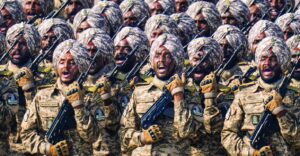
4 SIKH LI (Bhairav Commando) in Republic Day Parade -2026
There is a social media debate doing the rounds wherein objections on the exclusion of Mazhabi Sikhs (Valmiki and Ramgarhia) from an ongoing recruitment drive in Punjab are being raised.
The matter was raised by Anand Ranganathan in a Twitter (now X) post as a statement on which he did not give any opinion.
It has also been expressed in a TV channel by a civilian named Gurpreet Singh. The link is shared – https://youtube.com/shorts/DQZzLc2k5D4?si=hPJcmQeQYxhAm5w7 Here the speaker is referring to the call to Punjabi Jat Sikh youth to register for recruitment of Agniveers in the Sikh Regiment. His tone and tenor attempts to create a perception that this is being done deliberately by the incumbent NDA government at the centre.
There is a need to clarify the process. To begin with, it needs to be clarified that the Indian Army operates a regimental system that predates Independence. The class based recruitment for certain fixed class units is not a recent innovation, nor a policy introduced by the current government—it is a legacy structure maintained across decades and governments.
In the evolution of the British Indian Army, the British identified a number of martial races from where recruitment was to be carried out. These included the Sikh, Gorkha, Rajput, Marathas, Dogra and many others.
The British further felt that organising these martial races into pure caste units would increase their motivation levels since they would be fighting for the respect and glory of their community. Further, this would facilitate ease of management in terms of culture, lifestyle and religious practices etc.
The British therefore organised these martial tribes into pure caste regiments giving birth to regiments like the Rajput Regiment, Gorkha Regiment, Sikh Regiment, Dogra Regiment etc.
The policy adopted by the British paid them handsome dividends since these Regiments maintained internal and external security for them in an exemplary manner throughout their colonisation in India.
There were some areas like Punjab and Rajasthan where the recruitment base was very large, thus requiring a number of Regiments. In Punjab, therefore, two Regiments were created – the Sikh Regiment that recruited only Jat, Khatri, Saini and other Sikhs and the Sikh Light Infantry (Sikh LI) that recruited “Mahzabi Sikh” to include Ramdasia, Valmiki etc.
The Sikh Regiment traces its origins to 1846, when the British raised Sikh units after the First Anglo-Sikh War. It evolved through various designations in the British Indian Army. It was formally grouped as the Sikh Regiment in 1941, before becoming part of the post-independence Indian Army in 1947.
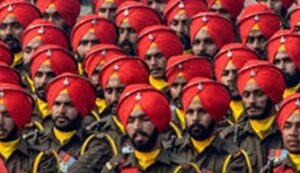
Soldiers of the Sikh Regiment in Ceremonial Dress
Sikh LI finds its roots go back to 1857, when units like the Mazhabi and Ramdasia Sikh companies were raised (notably during and after the 1857 uprising). These units were later organised into formations such as the Mazhabi Sikh Regiment. The regiment was re-designated as the Sikh Light Infantry in 1941.
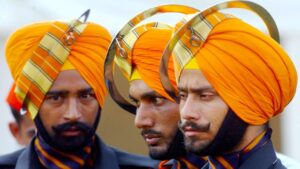
Soldiers of the Sikh LI Regiment in Ceremonial Dress
Post-independence, in view of the rich military traditions of these pure caste units, they were retained in the Indian Army in their original form. In order to expand recruitment, it was decided that all new raisings would be formed with “All India, All Class” configuration.
The system adopted by the Indian Army has paid handsome dividends as is evident from the rich military legacy of the service in performance of its duty towards the nation.
The recruiting offices of the Indian army carry out specific recruitment drives for the fixed class units from time to time while also carrying out rallies for the All class segment. This implies that when there will be a recruitment drive for the Sikh LI Regiment, the advertisement will specifically mention that only Mazhabi Sikhs should apply.
Those raising objections are either unaware or deliberately brushing aside the fact that all Sikhs are being recruited in the Army in different arms and services be it Armoured Corps, Artillery, Engineers and services like Ordnance and Army Service Corps etc. on an all class all caste basis and are also being recruited in their pure class Regiments – The Sikh and the Sikh LI.
This is not a question of one group being valued over another. Both regiments have fought with extraordinary courage, and both carry the honour of the Sikh martial tradition. Both, therefore, have an equally proud history and legacy of valour. Their soldiers have won several gallantry awards in the British and Indian Armies and units have won several Battle Honours and other decorations. They are the pride of the Indian Army
In fact, the Sikh LI, which has been so unceremoniously ignored by the speaker, has given three Chiefs of Army Staff to the Indian Army – General Ved Prakash Malik, General Bikram Singh and General MM Naravane.
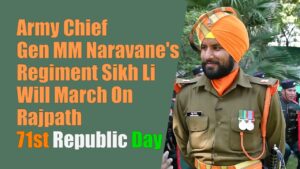
Military service has remained a chosen profession for Punjabis since millennia. In recent times the trend has witnessed a decline mainly due to the craze for migration. This situation does not behove well for Punjab, Punjabis and Punjabiat, since it heralds the decline of one among the richest military traditions in the world. It also heralds a loss for the Army and the nation
Veteran soldiers from Punjab, both officers and other ranks have been making great efforts to motivate the youth towards joining the army so as to reinvent the noble tradition. Particularly, the veterans of the Sikh and Sikh LI units are going from village to village in Punjab to motivate the youth when recruitment rallies for their Regiments are organised.
Sadly, elements with limited knowledge and huge vested political interests are indulging in misinformation to create insecurity in the minds of the youth and their families about the noble profession of arms.
It has been noticed that the moment recruitment gains momentum these elements initiate their ignominious and misleading campaigns.
Service with the Indian Armed Forces is the biggest honour for every Indian, especially the proud people of Punjab. Intake is through the most transparent means where merit is the only consideration.
The people of Punjab should not allow propaganda to inhibit their quest to pursue the noble profession of arms. Punjabis should identify and expose those who are creating dissension and divisiveness as enemies of the community!