Dr. Iqbal Singh Lalpura
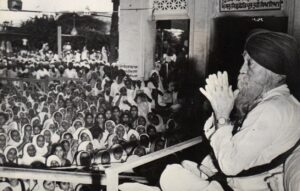
Master Tara Singh Aligned with the National Movement
The relationship between the Sikh community and the Indian National Congress remains one of the most significant yet least honestly examined chapters of modern Indian history. It began with trust, sacrifice, and shared struggle during the freedom movement, but over time evolved into mistrust, confrontation, and unresolved constitutional questions. Much of the later turmoil in Punjab cannot be understood without revisiting the assurances made to the Sikhs before Independence and the manner in which many of those promises remained incomplete after 1947.
The partnership between the Congress and Sikh leadership was forged during the Gurdwara Reform Movement of the 1920s. Sikhs launched a peaceful agitation to liberate their historic shrines from corrupt mahants enjoying British patronage. Thousands courted arrest, faced brutal repression, and sacrificed their lives in a disciplined non-violent movement. The struggle deeply impressed national leaders. Mahatma Gandhi described the success of the movement and the passage of the Sikh Gurdwaras Act in 1925 as “the first decisive battle for India’s freedom.”
From that period onward, Sikh political leadership, particularly under Master Tara Singh, aligned itself with the broader national movement. At a time when communal politics was intensifying across India, the Sikh leadership chose to support a united and secular India rather than seek a separate arrangement. Despite being a small minority, Sikhs contributed disproportionately to the freedom struggle, revolutionary movements, and military service.
This support, however, rested upon repeated assurances from Congress leaders that Sikh identity, political rights, and regional aspirations would receive honourable accommodation in free India.
In 1929, the Congress adopted a resolution assuring minorities, including Sikhs, that no constitutional arrangement would be acceptable unless it satisfied them. In 1931, addressing a Sikh gathering at Gurdwara Sis Ganj Sahib in Delhi, Mahatma Gandhi reportedly declared that Congress would do nothing contrary to Sikh interests and that if it ever betrayed them, the Sikhs would be justified in resisting it.
The most frequently quoted assurance came from Jawaharlal Nehru in July 1946, when he stated that the “brave Sikhs of Punjab are entitled to special consideration” and that he saw “nothing wrong in an area and a set-up in the North wherein the Sikhs can also experience the glow of freedom.”
These assurances acquired enormous significance because the Sikhs had already suffered heavily during Partition. Punjab was divided, historic shrines were left behind in Pakistan, and hundreds of thousands of Sikhs were displaced. Yet despite immense suffering, Sikh leadership stood firmly with India.
The post-Independence period, however, marked a decisive shift in the attitude of the central leadership towards Sikh political demands. The optimism of partnership gradually gave way to suspicion. The demand for Punjabi Suba — fundamentally a linguistic state like those created for Telugu, Marathi, Kannada, and Gujarati speakers — came to be viewed through a communal lens.
Master Tara Singh himself later remarked that the “honeymoon with Congress” ended when he was arrested at Narela Railway Station on January 19, 1949, while travelling to attend a conference at Gurdwara Rakab Ganj Sahib in Delhi to discuss Sikh aspirations in independent India.
During this period, efforts were also made to weaken Akali leadership through political divisions and inducements. Influential Sikh leaders who had earlier enjoyed positions and privileges under the British administration were encouraged to join the Congress. Social divisions between Jat and non-Jat Sikhs, alien to the egalitarian principles of Sikhism, were increasingly exploited to politically isolate Master Tara Singh, who himself was a non-Jat Sikh leader.
Jawaharlal Nehru increasingly viewed Akali politics as sectarian and destabilising. A revealing glimpse into this mindset appears in Nehru’s letter dated December 29, 1953, written to Union Home Minister Kailas Nath Katju after disturbances at Fatehgarh Sahib involving Master Tara Singh and Akali supporters. In that letter, Nehru wrote, “I am inclined to agree that it is about time that Master Tara Singh’s pretensions were ended. He has had too long a rope.”
The letter reflected growing official hostility towards Sikh political mobilisation. Whatever one’s political interpretation, it is difficult to deny that by the early 1950s the Punjabi Suba movement was no longer being treated merely as a linguistic demand. It had become, in the eyes of the central leadership, a question of political control and national security.
This approach had long-term consequences. While other linguistic states were reorganised during the 1950s, Punjab remained unresolved for nearly two decades. The situation became further complicated when many Punjabi-speaking Hindus, influenced by political polarisation, declared Hindi rather than Punjabi as their mother tongue during census operations. A linguistic issue was transformed into a Hindu-Sikh divide.
During Nehru’s lifetime, the Punjabi Suba demand was never fully accepted. The complex relationship between Nehru and Master Tara Singh continued throughout this period. Ironically, the Akali Dal merged with the Congress twice — in 1948 and again in 1956 — in the hope that Sikh aspirations promised before Partition would finally be addressed.
The eventual breakthrough came under Prime Minister Lal Bahadur Shastri, who accepted the principle of Punjabi Suba. Shastri had deep respect for Sikh soldiers and the Sikh community. During the 1965 war, Sant Fateh Singh agreed to suspend his agitation for Punjabi Suba on the Prime Minister’s appeal, and Shastri honoured his commitment to support the reorganisation. Unfortunately, he passed away before the Hukam Singh Committee report could be implemented.
The reorganisation of Punjab was finally carried out in 1966 under Prime Minister Indira Gandhi through the Punjab Reorganisation Act. Yet even this settlement remained incomplete. Chandigarh was made a Union Territory instead of being transferred fully to Punjab. Several Punjabi-speaking areas were excluded, and river waters were placed under central arrangements which many Punjab leaders considered unjust. These unresolved disputes continue to influence Punjab politics even today.

Congress Leaders Brush Aside the Devastating Period of Militancy
The Anandpur Sahib Resolution of 1973 must also be viewed within this larger historical context. Though frequently portrayed as separatist, many of its provisions essentially demanded greater federal autonomy within the Indian constitutional framework. Several of its principles later found resonance in broader national debates on Centre-State relations. However, instead of engaging politically with these demands, sections of the establishment increasingly viewed Sikh political assertions through a security lens.
Punjab’s tragedy deepened during the late 1970s and early 1980s. Competitive politics, religious mobilisation, and administrative failures created conditions that eventually spiralled into militancy. Several former officials and analysts, including former IPS officer M.K. Dhar in his book Open Secrets and S.S. Sidhu in Khalistan Conspiracy, argued that certain political elements initially encouraged radical religious forces to weaken the Akali Dal politically. What may have begun as tactical political management ultimately escaped all control. The leader of today try to brush aside this monumental tragedy of militancy that was heaped on the people by their party
Punjab paid a devastating price. Militancy, terrorism, police excesses, assassinations, and fear scarred an entire generation. The crisis reached its most painful moment with Operation Blue Star in June 1984, when military action inside Sri Harmandir Sahib deeply wounded Sikh sentiments across the world.
An important and still unresolved question remains: who created, promoted, and fuelled militancy in Punjab? Understanding the roots of that tragedy remains essential if future generations are to avoid repeating the same mistakes. Unfortunately, neither Sikh intellectual circles nor sections of the diaspora have seriously undertaken a collective and objective examination of this painful period.
The assassination of Prime Minister Indira Gandhi was followed by the horrific anti-Sikh massacres of November 1984. Thousands of innocent Sikhs were killed in Delhi and other cities. Homes, businesses, and gurdwaras were destroyed while the state largely failed to protect its own citizens. Rajiv Gandhi’s statement — “When a big tree falls, the earth shakes” — further deepened Sikh alienation and pain. Delayed justice, inadequate rehabilitation, and the perception that many perpetrators enjoyed political protection for decades intensified the community’s sense of betrayal.
The Rajiv-Longowal Accord of 1985 offered hope for reconciliation. It promised solutions on Chandigarh, territorial disputes, river waters, and compensation. However, major portions of the Accord remained unimplemented. The assassination of Sant Harchand Singh Longowal soon afterward further weakened the prospects of a durable political settlement.
The healing touch expected by the brave and loyal Sikh community remained largely absent under successive Congress-led governments. However, leaders such as Charan Singh, V.P. Singh, Chandra Shekhar, I.K. Gujral, and Atal Bihari Vajpayee attempted, in different ways, to address Sikh grievances and restore confidence. The present national government under Prime Minister Narendra Modi has also undertaken several initiatives aimed at recognising Sikh contributions and promoting Sikh heritage globally.
At the same time, serious introspection is also required within Sikh political leadership itself. For nearly four to five decades, a powerful trio of Sikh leaders and their political establishments dominated Punjab’s religious and political landscape. They remained influential both in state politics and at the national level, often sharing power with successive governments in Delhi. Yet many core Sikh and Punjab-related issues — Chandigarh, river waters, Punjabi-speaking areas, justice for 1984 victims, rehabilitation of affected families, and long-term federal concerns — remained unresolved. Religious emotions and regional sentiments were repeatedly invoked during elections and agitations, but united and sustained efforts to secure permanent solutions were often missing. This failure of collective leadership also contributed to frustration within sections of Sikh youth and the diaspora.
The Sikh diaspora nevertheless carries an important responsibility. Sikhs living abroad remain emotionally connected to the trauma of Punjab and the memories of 1984. Their pain and concerns cannot simply be dismissed. However, lasting solutions in democratic societies emerge through dialogue, constitutional engagement, and democratic participation — not through anger, extremism, or the politics of confrontation.
Punjab today requires peace, economic revival, social harmony, and urgent attention to challenges such as drug addiction and youth alienation. The younger generation must be guided with honesty: historical mistakes and broken promises did occur, but the future cannot be built by remaining imprisoned in bitterness. Communities, like nations, progress through constructive engagement rather than perpetual resentment.
The need of the hour is not to reopen wounds for political gain, but to encourage honest dialogue between the Indian state, Sikh leadership, and the global Sikh community. India’s strength lies in its ability to accommodate diversity with dignity. Federalism, linguistic identity, and minority rights are not threats to national unity; they are pillars of a confident and plural democracy.
The Sikh community does not seek sympathy. It seeks fairness, dignity, and sincere engagement. A mature democracy must possess the courage to acknowledge difficult chapters of history and address genuine grievances with honesty rather than defensiveness. Serious reflection within the community and the nation can help transform past pain into a roadmap for reconciliation and progress.
Perhaps the time has come to recognise a simple truth: unresolved grievances do not disappear with time; they deepen silently across generations. Reconciliation demands not rhetoric, but moral courage, political honesty, and a shared commitment to national harmony.
Only then can the unfinished promises of the past give way to a more trusting and united future.
(The Author is former Chairman, National Commission for Minorities, Government of India)