Jaibans Singh
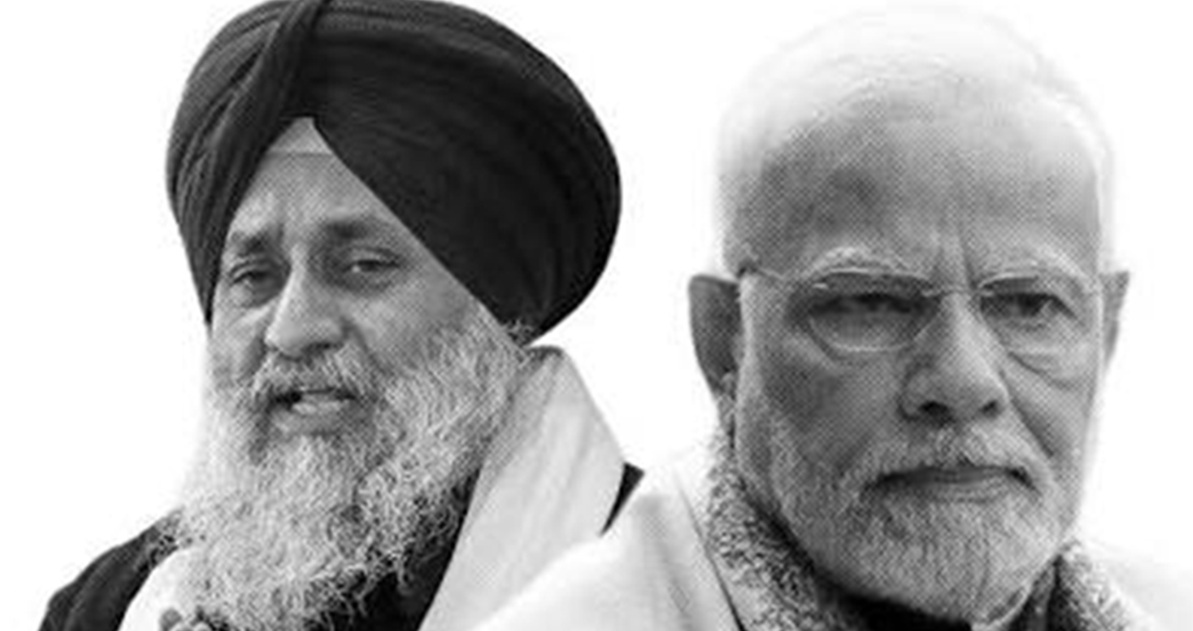
The proposition that a reunion of the Shiromani Akali Dal (SAD) and the Bharatiya Janata Party (BJP) will rejuvenate both parties is being advanced by a section of political leaders and supporters. Their argument rests on the historical strength of the alliance and the possibility of consolidating anti-incumbency votes against the Aam Aadmi Party (AAP).
While the media is indulging in high octane visibility to the issue, mostly in view of its sensational value, the BJP is insisting on its resolve to fight independently. Certain new inductions in the party and the degree of preparation across Punjab also indicates towards the “fighting independently” option.
The need of the hour is to carry out an assessment from the alliance from the historical point of view to the present situation and ascertain the benefits that it accrued to the two parties, and more so, the people of Punjab. Above all, is the willingness of voters to endorse the arrangement.
Overview
In the 1969 assembly elections, the SAD was short of a majority and formed a coalition government with the help of the Bharatiya Jana Sangh, the predecessor of the BJP. The roots of the coalition were laid at that stage. The government formed, however, was short-lived.
Following the Emergency, the SAD and the newly formed Janata Party (which included the former Bharatiya Jana Sangh) fought the 1977 elections in Punjab together and won a landslide victory. Parkash Singh Badal was chief minister of the coalition. It lasted for nearly two years and eight months before it was dismissed
The Rise, Consolidation and Decline
In 1997, the BJP-SAD coalition was reignited and it achieved a decisive victory with SAD getting 75 seats and BJP 18 seats.
- The success of 1997 was repeated by the coalition partners in 2007 when BJP won 19 of the 23 seats that it contested up from just three in 2002. Its vote share rose to 8.3 percent. Avinash Rai Khanna was then the State President of the BJP. Anti-incumbency against the outgoing Congress government contributed significantly to the alliance victory.
- In 2012, the BJP seat share fell drastically from the 19 seats in 2007 to 12. Nevertheless, the coalition got the required majority and formed the government for the second consecutive term. However, the downslide in the BJP had begun.
- In the politically important 2017 Assembly election with the NDA government in the centre the BJP would have been expected to do very well. Instead it suffered a considerable setback winning only three seats. Vijay Sampla was the President of the BJP at that stage. He was later appointed Chairman of the National Commission for Scheduled Castes in 2021 and served till 2023.
- BJP navigated the high-stakes 2022 Punjab Vidhan Sabha election facing unprecedented political isolation. It fought the election in coalition with Captain Amarinder Singh’s Punjab Lok Congress party and fielded candidates on 73 constituencies across the state. However, the party managed to garner a vote share of just 6.60 percent with a very low strike rate of approximately 2.7 percent and secured only two seats state-wide.
Analysis
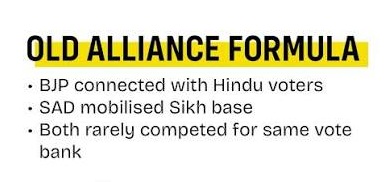
The Coalition was at its peak till such time that it upheld the high ideological platform of joining hands to strengthen Punjabiat by integrating the interest of the Hindu and Sikh communities of Punjab.
When the matter came down to governance, the coalition started losing its sheen mostly due to the corrupt and inefficient governance of the SAD. The BJP lost ground because it was perceived to be a party to the corruption and mis-governance of the SAD. In the parliamentary polls of 2024, the SAD came down to only 13 percent vote share with one seat won and the BJP had about 16 percent vote share with no seat won.
In the present scenario, the two parties have not come up with any new ideas that can motivate the people to vote for them should they get together. How then are the leaders of the two parties giving assurances to the centre that a coalition will help gain electoral majority in Punjab?
The Dynamics of the Coalition
Although the partnership was publicly projected as one of mutual respect and shared interests, its functioning was frequently influenced by the relative political standing of the two parties and their respective political ambitions. The principal considerations emerging from the evolution and functioning of the partnership are as follows:
- In the run up to the 1985 Punjab Vidhan Sabha polls, SAD was in a dominant position while the BJP, having been raised only in 1980, was still consolidating. SAD did not offer a coalition. It secured 73 seats and formed the government independently. Obviously, the SAD’s preference is more political than ideological in context.
- In 1997, the political landscape of Punjab was restructuring. Militancy had substantially subsided and democratic politics were being restored. The SAD repositioned itself through the Moga Declaration of 1996 and adopted the broader political formulation of ‘Punjab, Punjabi and Punjabiyat.’ The BJP, meanwhile, was emerging as a major national political force. The alliance was therefore driven substantially by electoral and political calculations, including the opportunity for the SAD to associate itself with the BJP’s expanding national influence. It was not simply a response to the disturbed conditions that had prevailed in Punjab during the preceding decade.
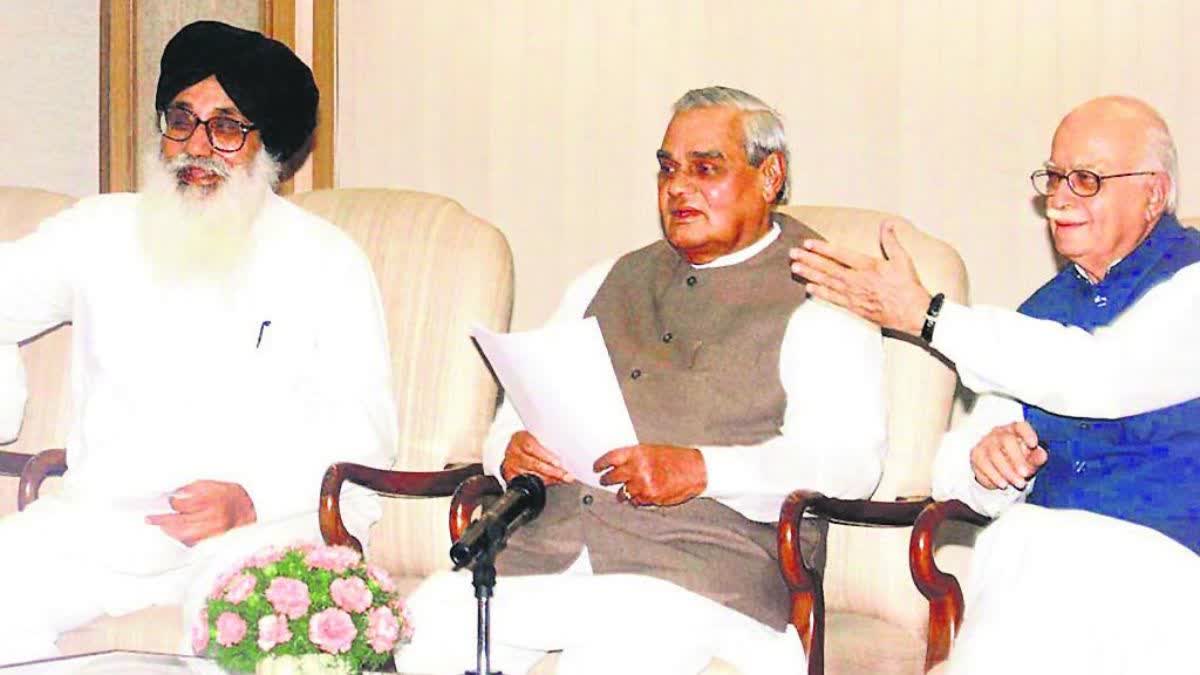
- Shri Atal Bihari Vajpayee and Shri LK Advani, representing the Jana Sangh-BJP political tradition, and Sardar Parkash Singh Badal, representing the SAD, remained the principal political architects of the partnership. Their personal equations and political understanding provided continuity across changing political circumstances.
- The partnership provided the SAD access to BJP’s emerging and strengthening national political establishment. Its association with the BJP-led NDA government enabled senior Akali leaders to occupy important positions in the Union government. The relationship thus extended the SAD’s political influence beyond Punjab and gave it a presence in national decision-making.
- Despite the BJP’s growing national stature, the arrangement within Punjab largely placed the SAD in the leading political role. The SAD contested the larger share of Assembly constituencies, headed the state government and retained the Chief Minister’s position. The BJP was allocated a smaller share of seats and participated in the government as a junior coalition partner.
- The continuance of this arrangement was also facilitated by a political narrative, propagated by sections within the SAD and other interested quarters, that the BJP could not independently secure a majority in Punjab because of its limited penetration into the rural Sikh electorate.
The underlying assumption that the BJP’s political prospects in Punjab were permanently constrained by its limited rural Sikh support was not an established political inevitability but a proposition that deserved to be tested against changing political and social realities. One, therefore, wonders as to why this arrangement was accepted by the BJP leadership? There are some more introspective questions that can be posed to the BJP, as follows: –
- If Congress followed by AAP could penetrate the Sikh votes, then why not the BJP? Why did the BJP convince itself that it needed a buffer from the SAD to gain legitimacy among Sikhs?
- What stopped the BJP from attempting a direct outreach to Sikhs when the coalition was not in government? Why was this natural political advancement rejected?
- Why did the BJP sit back and allow SAD to build institutional dominance by controlling the Shiromani Gurdwara Parbandhak Committee (SGPC), major Sikh religious institutions and most importantly rural political networks?
The Political Downturn
While the BJP got an opportunity to participate in government on multiple occasions from 1997 onwards and acquire valuable experience in administration and coalition management, it failed in generating sustained expansion of its electoral base.
The historic victory registered by the NDA in 2014, under the dynamic leadership of Shri Narendra Modi that continues to its third term helped BJP register tremendous electoral and political gains across the nation. The party formed governments in so many states where earlier it had struggled to find a foothold. However, in Punjab, where it had a considerable presence over many decades, it witnessed a downward spiral.
The party needed to connect with the traditional constituencies and articulate a political agenda that extended beyond the benefits of coalition government. Issues that affected Punjab’s political environment required sustained engagement, public communication and organisational follow-through. Whether these responsibilities received sufficient attention is a legitimate question for historical assessment.
The BJP did not just “fail” to relate with Sikhs, its leadership accepted the psychological limits posed upon it by the SAD. This decline raises questions about the capability of the current leadership
- Does it lack in commitment and ideological grounding exhibited by the earlier leadership like Dr. Baldev Prakash, Babu Hit Abhilashi, Madan Mohan Mittal, Balram Das Tandon and Manoranjan Kalia, Daya Singh Sodhi and Brij Lal Rinwa?
- Did it come under the influence of the larger father figure like the persona of Prakash Singh Badal and the continued guidance from the centre, and thus lost their autonomy?
The Pan-Punjab Signature
The break-up with SAD in the aftermath of the farm agitation gave an opportunity to the party to blossom on its own. Many joined the party with the intention of building a new Punjab. The first step in this direction was taken on the initiative of party leader Iqbal Singh Lalpura. At his behest, on June 16, 2021, six prominent Sikh personalities from Punjab joined the BJP in New Delhi. The group inducted by Union Minister Gajendra Singh Shekhawat included
- Jaibans Singh, a well-known media personality and an expert in political and strategic affairs
- Harinder Singh Kahlon & Kuldeep Singh Kahlon, who had remained Presidents of the All India Sikh Students Federation (AISSF).
- Jaswinder Singh Dhillon, former Vice-Chancellor of Guru Kashi University
- Jagmohan Singh Saini, advocate and President of Farmers’ Intellectual Front (Patiala)
- Nirmal Singh, an advocate from Mohali.
It was a declaration by the party that it would strengthen its base and bridge gaps with the Sikh community following the alliance split. The development was widely reported by the media and then observed with keen interest.
The Rapid Expansion
The joining of the first six Sikhs opened the floodgates. The party, in a bid to boost its presence in Punjab resorted to a free for all induction. Anybody and everybody who wished to join was welcomed. The induction was not discussed with the local BJP cadre who had remained loyal to the party for generations. Not much thought was given to the degree of influence or the cadre strength that was coming with the leader. It is quite apparent now that the big faces of Punjab politics who had been welcomed in the party fold with open arms came empty handed
Further, no effort was made to integrate the new entrants with the party philosophy through conduct of work-shops and orientation courses. This policy increased the BJP’s geographical spread, but diluted its ideological cohesion at the grassroots, and increased dependence on individual leaders rather than cadre networks.
Strengthening of the BJP
It is, however, to the credit of the BJP that in a small window of about eight months it created a structure to fight 73 out of the 117 seats of the Punjab Vidhan Sabha. Its candidate list had about 50 percent Sikhs, most of whom had joined from other parties.
- Over a period of time, young, committed, energetic leaders have joined the party and are working hard at the grass roots.
- The work of these grassroots leaders is not being projected as it should to the senior leadership at the centre.
- There is also a feeling among the junior cadre the information being fed to the national leaders is devoid of positivity.
Coalition does not Suit the BJP
There are some more points that need serious consideration:
- SAD under the Badals has no takers in Punjab, it will not be able to politically reach out to the people.
- The control of SGPC by the Badals is anathema for the people of Punjab. It also goes against the Sangh/BJP ideology that religious institutions should remain autonomous. How will the BJP adjust this ideological mismatch?
Overall, the SAD will once again saddle the BJP with the hatred that the people of Punjab nurture for it.
It is more important for BJP to win the ideological battle rather than the political battle in Punjab. By realigning with a corrupt, decrepit, party like SAD it will lose the ideological war without even giving a good fight.
A re-alliance with SAD will put paid to the aspirations of the thousands who are quietly, efficiently and relentlessly working towards building a nationalist view in Punjab. It will destroy all the good work that they are doing after having put their faith in the Sangh/BJP. They will lose direction and focus to an extend that it will become difficult to pick up the piece anytime in the future.
The Inherent Contradictions
- The electoral difficulties being faced by the alliance were already evident in 2017 and 2019. Therefore, the reunion must address the causes of that decline along with the consequences of the separation.
- The electoral expansion of the BJP has altered the balance of power between the two parties. The old arrangement of senior-junior partnership is no longer relevant. A coalition would require substantial renegotiation.
- The SAD is not necessarily the sole representative of the Akali political constituency today. Its reconciliation with the BJP will not automatically bring back voters who have moved towards other Akali formations or political alternatives.
- The mathematical addition of vote shares is not a reliable measure of the votes that the parties have the capacity to garner. Why would a BJP voter automatically vote for an SAD candidate or vice-versa?
- Will a section of Sikh voters who moved away from the SAD because of its political compromises accept a renewed alliance with the BJP?
- Why should voters consider the coalition a credible alternative when both parties have previously governed Punjab and have to account for their own records?
- Can the two parties agree on a common position on agriculture, federal relations, the state’s financial autonomy and Sikh religious and political concerns?
- The coalition needs a new political and governance compact. Repeating the old formula of electoral cooperation and caste based division of constituencies will not, by itself, answer the questions facing Punjab.
Concluding Remarks
The future of the BJP–SAD alliance must be assessed against the fundamental changes that have taken place in Punjab’s political and social landscape.
The SAD, which historically derived its legitimacy from representing Sikh religious, political and regional aspirations, has witnessed a steady erosion of its credibility and electoral support due to domination for decades by a single family. This decline has also had implications for the BJP, whose political standing in Punjab remained closely linked to its association with the SAD.
Punjab today presents a substantially altered political environment. While Sikh identity and Panthic concerns continue to hold considerable significance, questions of good governance, and administrative integrity have assumed increasing importance in public discourse. In this context the SAD’s perceived association with corruption and questions surrounding its governance record could become a liability for the BJP.
People are looking towards the Hon’ble Prime Minister to give Punjab a strong, crime-free and drug-free government, based on the governance models associated with Uttar Pradesh and Gujarat. The SAD can make no contribution in this matter.
The possibility of alliance and its positive impact on the people of Punjab, therefore, needs to be assessed while keeping all historical and contemporary situations in mind. Pressure from a few sources and the sensational advocacy of the media should not be the guiding force behind this very sensitive decision