Colonel Iqbal Singh
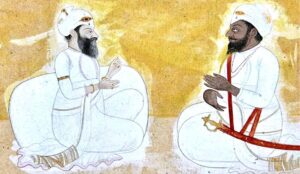
The Painting Depicts a Meeting between Jassa Singh Ramgarhia (left) and Amar Singh of Phulkian Misl
Jassa Singh Ramgarhia was more than a military commander. He was the living continuation of a Sikh resistance that stood unyieldingly against foreign rulers and invaders. It is believed he carried the blessings of his elders and of Guru Gobind Singh Ji (1666-1708).
His story did not begin with him. It began with his grandfather, Bhai Hardas Singh Ji (martyred 1716), a close associate of Guru Gobind Singh Ji. He was baptised by Guru Gobind Singh ji. He fought in most of the Guru’s battles in the Shivalik hills and later alongside Banda Singh Bahadur (D1716). He was also one of the scribes in Guru Gobind Singh Ji’s court at Anandpur Sahib. Bhai Hardas Singh Ji fell a martyr at the Battle of Bajwara, near Hoshiarpur, after killing Mughal commander Daler Khan in combat under Banda Singh Bahadur’s command. One of the pothis he scribed, signed by the Guru, was housed in the Sikh Museum in Amritsar but disappeared during Operation Blue Star in 1984. Media reports claim it later surfaced in Europe and was sold at a high price.
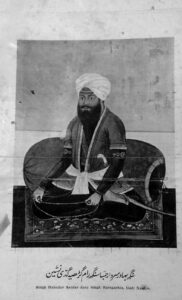
After Banda Singh Bahadur’s execution (1716), Sikhs were leaderless, directionless, and operated in small bands, keeping the Guru’s teachings alive. His son, Giani Bhagwan Singh (D1739), preached Sikhism with a following of about 200 men. When Nadir Shah of Afghanistan invaded Punjab in 1739, Mughal commanders sought local support to resist him. Giani Bhagwan Singh joined them, seeing Nadir Shah as the greater threat. At the Battle of Wazirabad in 1739, he fell fighting. His sons fought beside him with such valor that the Mughals granted them a few villages. The eldest was Jassa Singh.
Jassa Singh s/o Giani Bhagwan Singh joined Jai Singh Kanhaiya and later led the Ramgarhia Misl. He rebuilt and strengthened Ramrauni Fort—later renamed Ramgarh after Guru Ram Das, founder of Amritsar—each time it was destroyed. For this, he came to be known as Ramgarhia, just as Jassa Singh Ahluwalia was named for his village, Ahlu.
Jassa Singh Ramgarhia’s name is etched into Sikh history through decisive acts:
- The Capture of Delhi: In 1783, he stormed the Red Fort with Jassa Singh Ahluwalia and Baghel Singh, striking at the heart of Mughal power. The Mughal coronation stone was removed from the Red Fort and brought to Amritsar, where it was placed in the Bunga. It is still lying there.
- Defeat of Abdali: In a joint operation with Jassa Singh Ahluwalia and Charat Singh, grandfather of Maharaja Ranjit Singh (1780-1839), he and fellow commanders defeated and humiliated Ahmad Shah Abdali.
- Shivalik Campaigns: He brought parts of the Shivalik hills under Sikh control for the first time since Guru Gobind Singh Ji’s era.
- Defense of Harmandir Sahib: He built the Bunga to protect the Golden Temple from repeated Afghan attacks. The importance of Bungas is still recited in Sikh prayers.
Each act honored the legacy of his grandfather and strengthened the Sikh Panth.
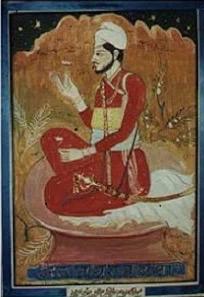 Ramgarh Fort became one of the strongest Sikh strongholds. It was repeatedly demolished by external adversaries and finally dismantled by Maharaja Ranjit Singh in 1816 after the death of Jodh Singh (D1816), Jassa Singh’s son. The Ramgarh fort stood near Gurdwara Shahid Ganj in Amritsar. After the martyrdom of Baba Deep Singh Ji, Jassa Singh laid the foundation stone for a gurdwara in his memory, later looked after by Akali Phoola Singh. The family maintained a private cremation ground adjoining it. My father was the first to be cremated in the public cremation ground after the land was donated to the SGPC for expanding Gurdwara Shahid Ganj. A stone commemorating this still stands in the complex along with the Samad of Jodh Singh Ramgarhia.
The Ramgarhia Misl was so formidable that Ranjit Singh could not absorb it as long as Jassa Singh and his son lived. Jassa Singh died in 1803. His son, Jodh Singh, took charge and served as Ranjit Singh’s ally until he died in 1816, becoming part of the Maharaja’s great Darbar.
Jodh Singh led the 1807 campaign against Kasur near Lahore and captured Nawab Qutb-ud-Din. It was in this battle that a 16-year-old Hari Singh Nalwa first saw action under his command. Jodh Singh also supported the Multan campaign, cementing his reputation as both warrior and statesman. His samadhi stands beside that of Baba Deep Singh Shaheed. In the mid-1960s, my father and family donated our family’s adjoining land to the SGPC for the expansion of the gurdwara complex.
After Jodh Singh’s death, internal family disputes weakened the Misl, and Ranjit Singh absorbed the Ramgarhia territories.
The legacy continued. Jodh Singh’s nephew, Diwan Singh, served in Kashmir from 1820 until he died in 1834, administering Baramulla while residing in Srinagar. After his death, his son, Mangal Singh, also served Maharaja Ranjit Singh. In 1834, he was sent to Peshawar with 500–600 men where he built forts as Ranjit Singh expanded toward Kabul. He was later holding the Jamrud Fort under the overall command of Hari Singh Nalwa (D1837). During the Battle of Jamrud in 1837, Mangal Singh held the fort where Hari Singh Nalwa fell.
The continuity is striking: Hari Singh Nalwa fought his first battle under Jodh Singh Ramgarhia at Kasur in 1807, and his last battle at Jamrud near Peshawar in 1837 while Mangal Singh Ramgarhia held the fort. Three generations of Ramgarhias stood alongside one of Sikh history’s greatest warriors.
After Ranjit Singh’s death, the Sikh Empire fractured. Following the Second Anglo-Sikh War, the British absorbed most Sikh forces. Mangal Singh remained in the service of the Panth, managing Harmandir Sahib and other gurdwaras in Amritsar from 1862 to 1879. Before the SGPC existed, the family safeguarded these institutions. When the SGPC was formed in 1924, his son became its second President. For three more generations, the family remained in charge of the Golden Temple until the mid-1940s. They also preserved Bunga Ramgarhia, built for the protection of the Golden Temple, and ensured it was not demolished by the SGPC during expansions of the parikarma, unlike several other historic structures.
The story of Jassa Singh Ramgarhia is not just family history. It is the story of Sikh resilience, sacrifice, and sovereignty of a family—carried forward across generations, from the 1680s to the 1950s, on battlefields, in gurdwaras, and in service to the Panth. My father was under pressure to hand over the Bunga to the Archaeological Survey of India but chose the SGPC instead, for obvious reasons. Bungas were built for the protection of the Golden Temple, and their role is remembered in Sikh prayers.
Jassa Singh Ramgarhia was popularly addressed as Maharaja by his followers. Many footprints of Jassa Singh and the Ramgarhia legacy remain. It is also believed that if the Ramgarhia Misl had allied with the British instead of Ranjit Singh—like the Phulkia and Ahluwalia misls—the family would have retained real estate assets worth billions of dollars. But that was not destined and destined to serve the Panth. Jassa Singh along with Baghel Singh carried out many raids against local commanders in UP and he also fought against the Raja of Pataudi while supporting the Phoolka Misl. However, this is the story of Bhai Hardas Singh ji and his legacy.
(Col Iqbal Singh (retd) is the direct descendent of Bhai Hardas Singh Ji)