Shokin Chauhan

I have stood on the Line of Control on winter mornings when even the sun seemed hesitant to rise. I have watched our patrols trudge through the frozen valleys of Dras and seen the distant ridges across which the Pakistani posts lie, almost within calling distance, yet separated by history’s cruellest boundary. And I have studied, as every soldier must, the other side of Pakistan, the western frontier, the Durand Line, where mountains higher than ambition and tribes older than empire continue to defy the map. These two lines, the Durand Line to the west and the Line of Control to the east, are not just cartographic accidents. They are scars, reminders of colonial haste, religious politics, and geopolitical insecurity. Between them lies Pakistan: a state born out of fear, defined by borders, and forever trying to legitimise itself through conflict.
Pakistan is, in a sense, an artificial country between two disputed lines, a nation whose borders were drawn by others and whose existence depends on the tensions those borders continue to create. To understand Pakistan, one must understand the ghosts of these two lines.
The Birth of an Artificial Nation
Pakistan was conceived not through the slow, organic growth of a people into a polity, but through an act of political surgery. The British Raj, exhausted after World War II and facing rising Indian nationalism, decided to cut India apart to create a Muslim-majority homeland. It was an idea born more of fear than of unity, fear of Hindu domination, fear of minority status, and fear of political irrelevance. And probably, the most important fear of all, fear that a large independent India straddling such a strategically important space in Asia might not be a convenient tool for the Western powers to dominate and that triggered the illegal birth of an artificial nation and left it in perpetual conflict.
Muhammad Ali Jinnah’s Two-Nation Theory provided the ideological cover, but even he had not imagined a country that would have no shared language, culture, or geography linking its two wings, East and West Pakistan, separated by 1,600 kilometres of India. The very structure of Pakistan was artificial and very specifically because of the following reasons: firstly, it was geographically fragmented at birth. Secondly, it was ethnically divided between Punjabis, Sindhis, Pashtuns, Baloch, and Bengalis. Thirdly, because it was always dominated politically by a small elite from Punjab and the Urdu-speaking migrants from India. The tragedy was that religion, Islam, was the only glue that held this mosaic together. Yet Islam, as history has shown, is too broad and diverse to serve as a single political adhesive. Within decades, Pakistan’s eastern wing rebelled, leading to the creation of Bangladesh in 1971. What remained, the western half, was left facing two restless frontiers, both inherited from the British, both contested, both fatal to the stability of any young state.
Few nations in the world live perpetually between lines, lines drawn by others, lines they neither fully accept nor can fully erase. Pakistan is one such country. Born between two disputes, the Durand Line to its west, cutting through the heart of Pashtun lands, and the Line of Control to its east, carved in blood and ice across the Himalayas, Pakistan has spent its entire life as a state struggling to define itself between boundaries that were never truly its own.
I have watched these lines from the vantage of a soldier, sometimes through the crosshairs of a night scope, sometimes on a map during a strategic briefing. Lines on maps have a curious power: they start as diplomatic instruments, and end as trenches. Pakistan, to my eyes, has lived inside such a trench for seventy-five years, neither fully sovereign nor truly stable, always a frontier, always a client. And now, as its economy collapses and its politics fracture, it is not just defending its lines; it is selling them.
The Idea of Pakistan and the Fragility of its Foundations
The story began in 1947, when the subcontinent’s feverish dream of independence gave birth to an entity conceived in haste and divided by faith. Pakistan was not a country born of geographic unity, linguistic coherence, or economic logic. It was, rather, an idea, an aspiration for Muslim political space, drawn across territories that had never before been governed together. The new state inherited provinces with disparate cultures and languages, from the rugged tribal mountains of the northwest to the riverine plains of Punjab and the deserts of Sindh.
From its very inception, Pakistan’s ruling elite felt insecure, encircled by what it perceived as hostile forces, haunted by the loss of Kashmir, and burdened by the illusion that Islam alone could bind its contradictions. It became a country defined by its fears. Its military, rather than its civilians, became the guardian of this brittle identity. And a garrison state was born, a nation that built tanks before it built trust, and missiles before it mastered bread. But what happens when such a garrison state begins to lose its means to feed its garrison? That, in essence, is Pakistan’s tragedy today.
The Highest Bidder
Old Pashtun saying- “Sahib, when a man loses his honour, he sells his land; when a state loses its soul, it sells its borders.”
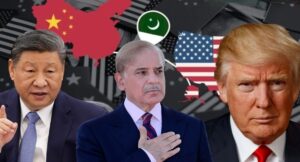
But now, those same mountains have become currency. In the chaos of Pakistan’s collapsing economy, the frontiers that were once defended with blood are being offered to the highest bidder. China, seeking access to the Indian Ocean and influence over Afghanistan, has extended its tentacles deep into these regions. Roads, tunnels, and military logistics routes built under the banner of the China–Pakistan Economic Corridor (CPEC) slice through the old tribal heartlands. On paper, they are infrastructure projects. In reality, they are the arteries of strategic control. China has invested over sixty billion dollars in Pakistan, most of it in areas that are politically volatile and ethnically alienated. The Chinese build the roads, operate the mines, control the energy projects, and secure them with the silent approval of the Pakistani army. What was once the free tribal frontier is now a corridor owned by Beijing, a highway for influence, guarded not by Pakistani sovereignty but by Chinese capital. The Pashtun tribes see it for what it is: the latest in a long line of occupations, this time not by empire but by debt. The Durand Line, once a scar of colonial arrogance, is now being buried under Chinese asphalt.
The Eastern Frontier – The Line of Control
If the Durand Line is Pakistan’s legacy from the British, the Line of Control (LoC) is its inheritance from Partition, another legacy of the British. The princely state of Jammu and Kashmir, at the moment of independence, was caught between two choices: join India or Pakistan. Its ruler, Maharaja Hari Singh, a Hindu, delayed the decision, hoping to remain independent. When tribal raiders from Pakistan’s North-West Frontier, backed by the Pakistani Army, invaded in October 1947, the Maharaja legally acceded to India and then sought India’s help. India immediately airlifted troops to Srinagar after the Instrument of Accession was signed. The war that followed ended with the Ceasefire Line of 1949, later renamed the Line of Control after the 1972 Simla Agreement. This Line of Control divides the former princely state into two unequal parts: about one-third under Pakistan’s control (Pakistan-occupied Kashmir and Gilgit-Baltistan) and the remaining two-thirds with India. For Pakistan, Kashmir became a self-made unfinished business of Partition, a moral and ideological obsession. For India, it has always been a matter of its sovereignty.
Kargil – The Peak of Deception
In 1999, Pakistan’s attempt to seize the heights of Kargil was one of the most audacious betrayals of peace. While political leaders in both countries were exchanging handshakes in Lahore, Pakistani soldiers and militants were occupying Indian positions across the Line of Control. Later, as the General Officer Commanding the Kargil, Dras, Batalik sector, I still remember seeing those heights and marvelling at how our young Indian officers led impossible assaults up sheer cliffs, of men fighting in oxygen-thin air at altitudes above 16,000 feet. The enemy had the advantage of height; our troops had the advantage of courage. Kargil was more than a tactical operation; it was a reflection of Pakistan’s strategic psychology. Unable to win conventionally, it relies on deception, proxies, and deniability. The Line of Control, for Pakistan, is not a line to respect but a corridor of infiltration.
Pakistan’s National Character – Fear, Faith, and the Fortress Mentality
Living between two disputed lines has shaped Pakistan’s very nature. It is a state perpetually in siege mode, convinced that survival depends on military strength and external alliances. The Pakistani military is not just a defender of borders; it is the state’s central institution, its economic powerhouse, and its ideological architect. Civilian governments come and go, but the army remains the constant, the self-declared guardian of Pakistan’s “ideological frontiers. “This has led to what many scholars call the garrison state, a polity where everything, from education to media, is filtered through the lens of security. The two frontiers, with India and Afghanistan, feed this siege narrative of enemies on both the east, the “Hindu enemy”, and to the west, the “unreliable Afghan brother.” Inside Pakistan lies a restless population, fragmented by ethnicity but held together by the politicians and the Pakistan army’s narrative of an external threat. In such a system, peace is dangerous. It weakens the military’s control. Conflict, on the other hand, justifies budgets, power, and ideology. Pakistan’s economy has often been on the verge of collapse, its politics chaotic, yet the army’s hold remains unshaken. Every external crisis, from Kashmir to Kabul, becomes a further justification for its dominance.
The Auction Begins: America Returns, and Balochistan is on the Block
But even China’s embrace has limits. As Pakistan’s economy plunged into default and its rupee collapsed, Beijing’s patience wore thin. Loans were delayed, projects stalled, and whispers spread of Chinese disillusionment. It was then that Pakistan, desperate for new patrons, began looking west again toward Washington and, intriguingly, toward the Gulf.
In recent months, reports have surfaced of Pakistan offering critical mineral assets in Balochistan to American investors, even as Chinese companies already operate in the same region. During a closed-door meeting between General Asim Munir and U.S. President Donald Trump, there was talk of granting the Americans access to Balochistan’s vast reserves of copper, lithium, and rare earths. Shortly thereafter, Pakistan shipped its first consignment of rare earth minerals to the United States under a $500-million partnership deal. The irony is brutal. For years, Pakistan accused the West of exploiting Muslim lands. Now, in its hour of economic collapse, it is offering those same lands as collateral. The rugged hills of Balochistan, once the refuge of rebels, now the repository of global mineral wealth, are being carved into mining concessions, each negotiated not in Islamabad’s parliament but in military headquarters and foreign boardrooms.
Even the Americans understand the game. Their interest is not philanthropy. It is a strategy to counter Chinese influence, secure alternative mineral sources, and maintain a foothold in a region where geography still dictates power. If China controls Gwadar, the U.S. may soon anchor itself at Pasni, another Pakistani port slightly up the coast. Two great powers, two harbours, one desperate host.
The Gulf Connection: Selling the Desert and the Shore
Nor are China and the United States the only players. The Gulf monarchies, long accustomed to renting Pakistan’s soldiers and subsidising its clerics, are now eyeing its land. The barren stretches of Sindh and Balochistan are being marketed as “investment zones” to Saudi and Qatari sovereign funds. There is talk of long-term leases for agriculture, energy, and logistics. What began as labour export, Pakistan sending its men to guard Gulf palaces, is evolving into territory export: Pakistan offering pieces of itself for Gulf money. It is a bitter reversal. Once, Pakistan prided itself on being the guardian of the Islamic world, the only Muslim nuclear power. Today, it is auctioning the same deserts where its soldiers once trained for pan-Islamic solidarity.
A Nation Leasing Its Future
As a soldier, I have seen what it means to hold ground. You fight for every ridge, every river crossing, every scrap of high ground, not for ideology, but because terrain is life. You never trade it lightly. Yet Pakistan, trapped between debt and delusion, has begun to trade its terrain piece by piece: mines to China, ports to America, and lands to the Gulf. The term “selling” may sound harsh, but that is precisely what it is. When a state grants a foreign power long-term control over its strategic infrastructure in exchange for money or loans, it is selling sovereignty. The transactions may wear the clothes of investment, but beneath them lies surrender. For Pakistan, this process is not new; only now it has become irreversible. During the Afghan wars, it sold its airspace and intelligence. During CPEC, it sold its infrastructure. Now, in the mineral deals of Balochistan, it is selling its very soil. Each time, the justification is survival. Each time, the consequence is dependency. And each time, the generals, not the civilians, make the deal.
The Soldier’s View: The Cost of Compromise
Standing on the Line of Control or flying over the Thar desert, one realises that geography is destiny. For all its ideological posturing, Pakistan’s real strength and vulnerability lie in its location. Wedged between the Himalayas and the Arabian Sea, bordering Iran, Afghanistan, India, and China, it occupies one of the most complex geopolitical junctions on earth. Every empire, British, American, and Chinese, has coveted that location. And every Pakistani regime has sold it in instalments.
The soldier in me cannot help but see the irony. The same army that boasts of defending every inch of the homeland has presided over the quiet sale of its most strategic regions. Balochistan’s copper and lithium mines, the ports of Gwadar and Pasni, the air bases once used by Americans, and the roads now owned by Chinese investors, all of them are the spoils of Pakistan’s misgovernance. And yet, the common Pakistani soldier, the man guarding these two disputed illegal lines, believes he is fighting for his homeland. He is sincere, even heroic. But the state he serves is compromised. Its generals dine with foreign envoys; its bureaucrats negotiate leases; its politicians recite borrowed slogans. The real war for Pakistan’s independence is not on the Line of Control; it is in the contracts signed behind closed doors.
The Strategic Consequences
For India, this is both an opportunity and a warning. The more Pakistan entangles itself with external powers, the more unstable its internal politics will become. Chinese investments have already provoked Baloch insurgents, who now target CPEC convoys and power plants. American interests, if introduced, will multiply those fault lines. Balochistan is very likely to become the world’s next geopolitical fault zone, a place where Chinese, American, Gulf, and local interests collide violently.
For the wider region, Pakistan’s transactional geopolitics may invite a new form of colonialism, not of flags, but of finances. Ports may carry Pakistani names, but their revenues flow elsewhere. Mines may lie under Pakistani soil, but their riches fuel foreign industries. The old imperialism came with gunboats; the new one arrives with chequebooks.
Lessons from the Front
From my years in uniform, I can say this: Pakistan’s borders are not merely lines; they are fault lines of identity. On the Line of Control, we face an enemy trained, funded, and often misled by its own illusions. I have seen Pakistani soldiers, brave men, fighting for a cause they barely understand, their courage exploited by an institution that thrives on hostility and hatred, fuelled by deceit. On the Durand Line, I have read about a similar tragedy playing out among tribesmen, Pashtuns who have known no peace for a century, caught between Kabul’s claims and Islamabad’s control. A line drawn by colonial pens has condemned generations to statelessness and suspicion.
What are the ground realities of these two disputed lines? The Line of Control is one of the most militarised frontiers on Earth. On both sides, hundreds of thousands of troops stand watch. The partition divided not just land but lineage. The Durand Line, by contrast, is a ghost line. It exists in Islamabad’s maps and in border posts, but for the tribes who live along it, allegiance shifts with kinship and opportunity. Pakistan’s own statehood is weakest there, proof that artificial borders cannot command natural loyalty. Both lines remind us that maps drawn by empire have a half-life longer than their creators. The British left in 1947, but their borders still draw blood.
Pakistan’s Two-Front Fear
Pakistan’s strategic community often speaks of a “two-front dilemma”, India in the east and instability in Afghanistan to the west. But the truth is deeper: Pakistan’s greatest threat lies not outside, but within. It is a state that never fully integrated its frontiers, never defined its identity beyond negating India, and never learned to live without an enemy. Even today, Pakistan’s narrative to its own people rests on three pillars: Islam, Kashmir, and the Army. Take away any one of them, and the edifice trembles.
Between Two Disputed Lines – The Crisis of Legitimacy
Let us then return to the beginning, the phrase I used, “an artificial country between two disputed lines.” Let me now try to justify that phrase; it’s artificial, because its creation was political, not historical. Between two disputed lines, because its geography ensures it can never escape its borders. The Durand Line questions Pakistan’s western legitimacy. The Line of Control questions its eastern ambitions. Together, they trap Pakistan in a paradox, defending borders that others dispute, and disputing borders that others defend. This geography has produced a nation that looks outward for validation and inward with insecurity. Its foreign policy revolves around managing hostility rather than building peace. Its internal politics mirror its borders: tense, unstable, reactive. Pakistan’s repeated attempts to gain “strategic depth” in Afghanistan, and to “liberate” Kashmir through proxy war, are symptoms of the same disease, the inability to accept its own territorial reality.
What the Future Holds
Will Pakistan survive the ravages of history? Or, like all artificial states created in history, will Pakistan disappear and get amalgamated to the lands it was cruelly cut off from? History offers Pakistan two choices. Firstly, it can continue to live as a security state, forever defined by its conflicts, or it can become a normal state, focused on development, regional cooperation, and reconciliation. But such transformation requires courage of a kind not yet seen in Islamabad, which really means, the courage to accept the Durand Line as an international border and normalise relations with Afghanistan, the courage to stop using Kashmir as a national obsession, the courage to redefine national pride not through nuclear tests or militant proxies, but through education, stability, and peace. Our world has changed. The lines drawn in the 19th century cannot continue to dictate the fate of millions in the 21st.
Conclusion – Lines That Define, and Confine
As a soldier, I have learned that maps are deceiving. They show borders as neat lines; on the ground, in reality, they are chaos, mountains, rivers, villages, and lives torn apart. Pakistan is a product of such lines, created between two disputes, sustained by them, and often consumed by them. Its artificiality is not just geographic; it is existential. It was born out of the fear of India and remains trapped in that fear. The Durand Line divides its past. The Line of Control divides its present. And somewhere between them, Pakistan searches for a future it has yet to build.
India, for its part, will continue to hold firm, strong on defence, wise in diplomacy, and patient in strategy. Because while Pakistan’s borders were drawn by history, ours are held by blood, by generations of soldiers who stood on those lines so that others could sleep in peace. As I look back on those ridgelines of Kashmir and the distant mountains of the frontier, I realise that these borders tell a story larger than war. They remind us that nations built on insecurity seldom find peace, and that those built on civilisation, tolerance, and continuity endure beyond the lines drawn by man.