Jaibans Singh
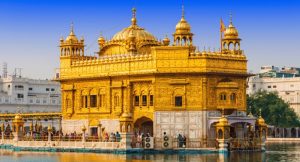
The debate over Sikhi being an independent religion or an extension of Hinduism has persisted for well over a century, even as the historical evolution of the Sikh faith presents a clear and continuous emergence of a distinct religion and spiritual tradition.
In the year 1499, following a spiritual enlightenment at Kali Bein near Sultanpur Lodhi, Guru Nanak proclaimed the immortal words, “Na Koi Hindu, Na Musalman” (There is no Hindu nor Muslim). This marked the beginning of a new spiritual path founded on devotion to one God, equality, honest living, and service to humanity.
Guru Nanak institutionalised this mission by appointing Guru Angad Dev as his successor, thereby establishing the unique tradition of living Gurus who successively nurtured and expanded the Sikh Panth.
In 1604, the fifth Guru, Guru Arjan Dev, compiled the Sri Guru Granth Sahib, incorporating not only the Bani of the Sikh Gurus, including himself, but also the hymns of revered Bhakti and Sufi saints from diverse backgrounds. The Sikh community, thus, acquired a sacred scripture of its own which reinforced its distinct spiritual identity.
Guru Arjan Dev’s martyrdom in 1606 marked the beginning of the Sikh community’s determined resistance to Mughal persecution and a quest for nationhood. The struggle reached its defining moment with the creation of the Khalsa by Guru Gobind Singh at Anandpur Sahib on 30 March 1699 (Vaisakhi), two centuries after the path was shown by Guru Nanak. The quest for freedom and self-rule continued for over a century and culminated with the establishment of the Sikh Empire under Maharaja Ranjit Singh in 1799.
Although Sikhi spread across the Indian subcontinent, its base remained Punjab. The people of Punjab embraced the Sikh faith and the Khalsa tradition in larger numbers. Punjabi Hindus revered the Sikh Gurus and the Sri Guru Granth Sahib without abandoning their own religious traditions. They also established a practice of dedicating their eldest sons to the Khalsa which continued for a long period of time. The result was a uniquely syncretic Punjabi society, bound together by common language, culture and kinship and a near universal belief in the Sikh Gurus and Sri Guru Granth Sahib.
Sikhi in the Colonial Era
The equilibrium changed during British rule. Colonial policies, particularly the encouragement of hereditary Mahants to control Sikh Gurdwaras, triggered the Singh Sabha Movement (from 1873) and later the Gurdwara Reform Movement (1920–1925).
The Gurdwara Reform Movement (commonly known as the Akali Movement) took place between 1920 and 1925 with the objective of freeing historic Sikh Gurdwaras from the control of hereditary Mahants (custodians) who were widely considered to be corrupt and morally infirm. They existed due to the support of the British colonial administration, which viewed them as politically reliable.
The movement began with Sikh reformers forming the Shiromani Gurdwara Parbandhak Committee in November 1920. Shortly afterwards, the Shiromani Akali Dal was established as a political wing. It organised agitations for the liberation of the Sikh shrines.
Several incidents became defining moments of the movement. The most tragic was the Nankana Sahib Massacre, in which over a hundred unarmed Sikh volunteers were killed while attempting to take control of the birthplace of Guru Nanak from the Mahant. Another notable episode was the Keys Affair, where the British returned the keys of the Golden Temple treasury after widespread protests. The Jaito Morcha also became a symbol of Sikh resistance against colonial authority.
The movement drew widespread public sympathy and eventually compelled the British Government to enact the Sikh Gurdwaras Act, 1925. The Act legally transferred the management of major historical Sikh Gurdwaras to the SGPC, making it the elected representative body responsible for their administration.
The Gurdwara Reform Movement thus reinforced the distinct identity of Sikhs and gave birth to enduring Panthic institutions such as the SGPC and the Akali Dal. It remains a defining chapter in Sikh political and religious history.
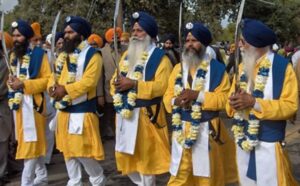
Pre-Independence Interpretation of Sikhi
The formation of separate Sikh institutions triggered a debate among religious scholars, historians, political leaders, and intellectuals on the status of Sikhi as a distinct religion. It did not take long for these debates to gain political overtones.
Mahatma Gandhi, the architect of the freedom struggle and a leader of the Congress repeatedly described Sikhism as belonging to the broad Hindu family and wrote in Young India in 1925, “I consider Sikhism to be a part of Hinduism.”
Annie Besant regarded Sikhism as one of the great reform movements within the Hindu civilization, emphasizing continuity in philosophical concepts such as Karma and rebirth.
In his literary works on the Hindu view of life and Indian philosophy published in the 1920’s, Dr. Sarvepalli Radhakrishnan, described Sikhism as a reform movement within the wider Hindu tradition, arguing that Guru Nanak sought to purify religion rather than establish a completely new one. Dr. Sarvepalli Radhakrishnan went on to become the second President of Independent India.
Acharya Vinoba Bhave, looked upon as the philosophical successor to Mahatma Gandhi, often referred to Sikhi as one of the noble streams of the broader Indian spiritual tradition.
It is no wonder then that the Congress leaders during the freedom struggle failed to understand the seamless bonds that existed between the people of Punjab bound by Sikhi and Sri Guru Granth Sahib. They looked upon the region as one with a diverse demographic dividend which made it a nursery for the warped two nation theory. This thought process of his contributed to the communal polarisation in Punjab that preceded the Partition of Punjab in 1947.
Recognition of Sikhi as a Distinct Religion
There was no dearth of intellectual voices that advocated the identity of Sikhi as a distinct religion and faith
R. Ambedkar consistently referred to Sikhi as an independent religion. During his search for an alternative to Hinduism, he seriously considered embracing Sikhi because he regarded it as a separate faith with its own doctrines and institutions.
Khushwant Singh, the noted journalist, author and Sikh historian wrote in his book “A History of the Sikhs,” that Guru Nanak founded a new religious tradition which gradually evolved into a separate religion under the later Gurus, particularly after the creation of the Khalsa in 1699.
H. McLeod, argued that while Sikhism emerged within the religious environment of North India, it developed into an independent religion with its own scripture, theology, and institutions.
Harjot Oberoi, a Professor of Asian Studies at the University of British Columbia, Vancouver, in his book, “The Construction of Religious Boundaries: Culture, Identity, and Diversity in the Sikh Tradition,” has argued that a distinct Sikh identity evolved over time and became clearly defined in the late nineteenth and early twentieth centuries.
S. Grewal, an Indian writer, historian, and scholar, who served as the vice-chancellor of Guru Nanak Dev University and was an expert in Sikh Studies, maintained that Sikhi evolved into a distinct religion through the teachings of the Gurus and the institutional development of the Panth.
Ganda Singh, a Sikh historian and Padma Bhushan awardee, emphasized that the Sikh Gurus laid the foundations of an independent religion with its own scripture, doctrines, and community.
Kapur Singh, who started his career as an Indian civil servant and later wrote about Sikh religion and politics while being a part of the SAD, defined Sikhi as an independent faith and rejected attempts to describe it as merely a reform movement within Hinduism. He was also the author of the Anandpur Sahib Resolution of the Akali Dal in 1973.
The fact that so many Sikh scholars had to, from time to time, reinforce the distinct nature of the Sikh religion gives an indication that there was a political agenda in those times to amalgamate the identity of the religion within the larger Hindu fold.
The resultant sense of insecurity propelled the SAD towards seeking a state that was predominantly Sikh in character. This led to the reorganisation of Punjab on linguistic lines in 1966 and creation of a new political framework.
However, the debate over the relationship between Sikhi and Hinduism has continued to surface from time to time, making it one of the most enduring and sensitive questions in modern Indian discourse.
The RSS and the Question of Sikh Identity
In the modern context many from the extreme right segment of the Sikh society allege that the Rashtriya Swayamsevak Sangh (RSS) maintains an agenda of absorbing Sikhi into the broader Hindu fold. The RSS, however, has explicitly refuted such allegations.
RSS spokesman, M. G. Vaidya, following a meeting between the RSS and the National Commission for Minorities in 2001 issued what is perhaps the first formal clarification on behalf of the RSS. “We regard Sikhism as a separate religion with a distinct ideology,” he stated
In 2003, Kuppahalli Sitaramayya Sudarshan, then chief of the RSS, made a significant statement acknowledging that Sikhi is a separate religion. During an interaction with Sikh leaders and the media, Sudarshan emphasized that Sikhi has its own scriptures, distinct traditions, religious practices, and historical evolution which gives it a distinct religious identity. He also maintained that Sikhs and Hindus belonged to the same cultural and civilizational family and shared many historical and cultural bonds. The statement was aligned with the RSS concept of cultural nationalism, under which diverse Indian faiths are seen as sharing a common civilizational heritage. The statement was welcomed by Sikh observers
Brij Bhushan Singh Bedi, a senior RSS functionary from Punjab who is also a practicing Sikh, in an official statement issued in October 2017 said, “Sikhism, like Buddhism and Jainism, is a socio-religiously recognised religion and Sikhs have a separate identity.” He further stated that the RSS has full reverence for the Guru Granth Sahib and Gurbani.
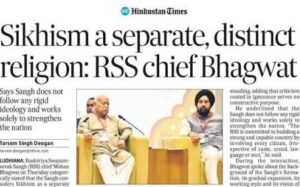
In February 2026, at Ludhiana, the RSS chief, Mohan Bhagwat, in one of the clearest statements said, “The RSS treats all citizens equally and considers Sikhism as a separate and distinct religion.” He added that the RSS views Hinduism as a way of life rather than merely a religion and called for respect for all faiths. A few days later, in Mumbai, Mohan Bhagwat reaffirmed that Sikhs have a distinct religious tradition and code of conduct, and their own distinct Panth.
The RSS has, since 2001, consistently given statements to reaffirm the organisation’s acceptance of Sikhi being a separate religion. Yet, there are many in Punjab, mostly intellectuals and some politicians, who insist that the organisation has a hidden agenda to assimilate the Sikh religion into the broader Hindu fold. The manner in which perceptions continue to outweigh explicit declarations made over more than two decades gives an impression of a political agenda driving the narrative.
Constitutional and Legal Recognition of Sikhi
The Constitution recognises Sikhs as a distinct religious community. Explanation II to Article 25 which states that references to Hindus in laws shall be construed as including persons professing the Sikh, Jain and Buddhist religions was inserted only for the limited purpose of enabling social reform legislation. It does not declare Sikhs to be Hindus, alter the independent religious identity of Sikhs or merge Sikhism into Hinduism. It should, therefore, not be misconstrued.
The Supreme Court has, on several occasions, recognised Sikhism as a distinct religion. In S.P. Mittal v. Union of India (1983), the Court observed that Sikhism is a distinct religion founded by Guru Nanak, possessing its own scriptures, doctrines and religious practices. In Bal Patil v. Union of India (2005), while dealing with the issue of minority status for Jains, the Court referred to Sikhs, Jains and Buddhists as distinct religious communities in India. Various other judgments relating to Sikh institutions and the rights of Sikhs have proceeded on the basis that Sikhi is an independent religion.
Under the National Commission for Minorities framework, Sikhs are officially notified as one of India’s six religious minority communities. The most recent Chairman of the National Minority Commission was S. Iqbal Singh Lalpura, a Sikh.
Sikh marriages are recognised under the Anand Marriage Act, 1909, which was strengthened by the 2012 amendment providing for separate registration of Sikh marriages. Major Sikh Gurdwaras are governed under specific legislation such as the Sikh Gurdwaras Act, 1925, reflecting the distinct religious character of Sikh institutions.
The Census of India records Sikhs under a separate religious category. Government application forms for passports, Aadhaar card, voter registration, educational institutions, recruitment, and other official records invariably provide “Sikh” as a distinct option under religion.
From the Constitution to statutory law, judicial pronouncements, census classification, minority rights legislation and administrative practice, the legal position in India is clear: Sikhi is recognised as a separate and distinct religion.
Contemporary Challenges Before the Sikh Panth
The Sikh religion is facing challenges not from the Indian Constitution, the government of any Hindu organisation, but from within. The biggest challenge is the process of conversion to Christianity. Missionary activity, particularly in Punjab during the nineteenth and early twentieth centuries, was seen as encouraging conversions. In recent times it has gained momentum especially in the Pentecostal stream of the Christian Church. The target population for this conversion process is the rural, weak and marginalised segments of the Sikh community
Various Deras and sects like the Radha Soami Satsang, Dera Sacha Sauda, the Nirankari Mission etc. have introduced religious teachings or practices inconsistent with mainstream Sikh doctrine.
The Way Forward
The historical debate over whether Sikhi constitutes an independent religion or not has been largely settled in Independent India. The Constitution of India, statutory law, judicial pronouncements, administrative practice, census classification and the broader social acceptance of Sikhs all unequivocally recognise Sikhi as a distinct religion with its own scripture, institutions, traditions and code of conduct. Organisations that were once perceived by many Sikhs as questioning this distinctiveness have, over the past two decades, repeatedly and publicly affirmed that Sikhi is a separate faith. Repeated revisits to this question by some is the outcome of political considerations.
The need of the hour is to nurture Sikhi by strengthening religious education, propagating the message of the Gurus and Gurbani, preserving the institutions and addressing the growing influence of competing religious movements. Most importantly, it has to be ensured that the younger generations remain rooted in Sikh values and identity.
As a new and vibrant religion, Sikhi has a lot to give to humanity. The Panth’s energies, therefore, would be better invested in expanding the spiritual reach of the religion, and presenting the universal message of Guru Nanak and the succeeding Gurus to humanity with confidence and conviction.