Jaibans Singh
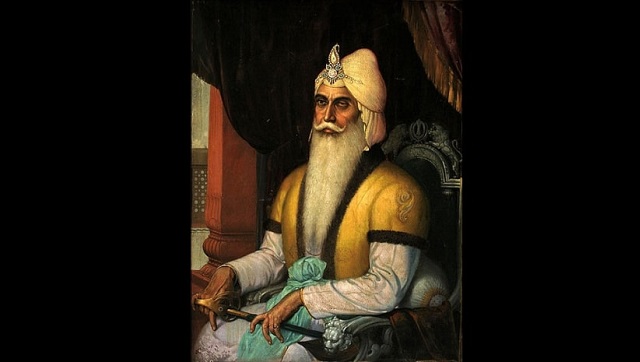)
Maharaja Ranjit Singh
On 27 June 1839, 185 years ago, Maharaja Ranjit Singh, the legendary Emperor of Punjab, who ruled northern and western India from 1801 to 1839, died at Lahore after a long illness. This article is a tribute to the great Maharaja, also called Sher-e-Punjab and Sher-e-Lahore, who was a true warrior, King and founder of the Sikh Empire. The Mughals, Afghans and British were equally wary of his visionary leadership, power, boldness, and bravery.
Childhood Cut Short
Maharaja Ranjit Singh, was born on 13 November, 1780, in the Sandhawalia Sikh family that held suzerainty of the Sukerchakia Misl. His father, Sardar Maha Singh, was chieftain of the Sukerchakia Misl; his mother, Bibi Raj Kaur, was the daughter of Raja Gajpat Singh of Jind State.
The Misls of Punjab were twelve independent military confederacies that emerged in 18th-century Punjab. They were autonomous principalities ruling over vast tracts of land united under the Dal Khalsa banner. In times of military crisis, they joined hands to fight for Punjab. The Sukerchakia Misl held suzerainty over the areas of Gujranwala, Punjab, now in Pakistan.
Ranjit Singh’s childhood name was Buddh Singh. He contracted smallpox as a child which resulted in the loss of vision in his left eye. It also left pock-marks on his face. He was short in stature but very agile and brave. He never went to school but learned Gurmukhhi and recitation of Gurbani. He mastered musketry, horse riding, archery, fencing and martial arts at an early age and was a particularly good horseman. He fought along with his father against the Chattha dynasty at the age of 10. His father was so impressed with his bravery in the battle that he renamed him Ranjit Singh (victorious Lion).
Ranjit Singh was only 12 years old when his father died. His mother Bibi Raj Kaur managed the Sukerchakia Misl along with a loyal chieftain, Lakhpat Rai. There were several attempts made by Hashmat Khan and others to assassinate him but he survived. His mother died when he was only 18 years old and his mentor Lakhpat Rai was also killed. Ranjit Singh then took charge of his Misl.
The Build-up of the Empire
After the death of Aurangzeb in 1707, the Mughal empire had started crumbling and gradually it lost all control in Punjab. The space was filled by the Khalsa Army after a sustained struggle with both the Mughals and the Afghans that lasted for more than a century. Meanwhile, colonial traders from Europe have also started establishing bases, but Punjab was affected by this evil force much later since the conspiracy took time to move from the South-East of the subcontinent to the west and finally towards the North.
By 1750, there were 14 Misls operating in Punjab. Twelve of these had Sikh suzerainty; the Kasur Misl had a Muslim head and one Misl also had a British head. By 1800, five major Sikh Misls (Sukerchakia, Ahulhuwalia, Nakkai, Kanhaiya and Bangis) came under Ranjit Singh through a clever weave of marriage diplomacy and use of military power.
Ranjit Singh modernised his Army and built it into one of the strongest fighting machines of those times. It comprised all fighting arms including horse cavalry, infantry and artillery equipped with the best available weaponry including the biggest cannons of those times.
He paid his soldiers well and did not differentiate on the basis of caste and creed. Hence he had French, Italian, Russians, Persians as soldiers in his Army, some of whom rose to the rank of generals. Of course, a major portion of the force comprised Sikhs and Hindus including Rajputs, Dogras, Brahmins and other Indian castes. His army drew strength from his secular thought process and was commanded by seasoned Generals like Hari Singh Nalwa, Zorawar Singh, Veer Singh Dhillon and Dewan Mokam Chand. He however did not trust the British.
The first major victory of Ranjit Singh was in 1797 when, in the Battle of Amritsar, he defeated the 12,000 strong Army of the Afghan king, Zaman Shah, which was led by Ahmad alias Shahanchi Khan. He was 17 years of age at that time.
In 1798, he encircled Zaman Shah’s Army in Lahore and cut off its supplies and forced the Afghan king to retreat. Emboldened by his victories he pressured the weakened Bhangi Misl of Lahore diplomatically and militarily and captured the city in 1799 with his 25,000 strong Khalsa Army. In 1800, the ruler of Jammu also ceded to his empire.
Ranjit Singh’s coronation as Maharaja of Punjab was held in 1801. He established his capital at Lahore. The investiture ceremony was performed by Baba Sahib Singh – a descendant of Guru Nanak. His rule was called Sakar-e-Khalsa and the court was known as Darbar Khalsa. He struck new coins called Nanak Shahi in the name of Guru Nanak.
In 1802, Maharaja Ranjit Singh took over Amritsar and paid homage at Harminder Sahib. He donated gold to gold-plate the outer façade. The Khalsa Army under Maharaja Ranjit Singh captured Kasur in 1807, Multan in 1818 and Sindh in 1821. He defeated Mohmmad Azim Khan in 1834 and recaptured Peshawar. He defeated Afghans in 1813, 1823, 1834 and 1835, the Battle of Jamrud in 1835 was his last battle between Afghans and Sikhs, in which the Sikhs emerged victorious.
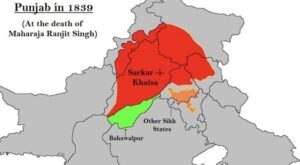
The Sikh Empire of Maharaja Ranjit Singh, at its peak, included all lands north of Sutlej, and south high valleys of Himalayas. The major towns under the empire included Srinagar, Attock, Peshawer, Bannu, Rawalpindi, Jammu, Gujrat. Sialkot, Kangra, Amritsar, Lahore, and Multan.
Maharaja Ranjit Singh managed the growing influence of the British with exemplary diplomatic finesse. He and the British were well aware of their relative power and did not wish to engage in conflict. This led to the inking of the Treaty of Amritsar, on April 25, 1809, between the British East India Company and the Sikh Empire which established the Sutlej River as the boundary between their respective territories. He signed a treaty with the East India Company in 1838 and restored Afghan rule in Kabul. The Khalsa Army participated in a joint Victory Parade along with the British in Kabul.
Family of Maharaja Ranjit Singh
Ranjit Singh strengthened his empire through matrimonial alliances. He, therefore, had many wives, including Rajput princesses. Among the most significant comes his first wife Mehtab Kaur, the only daughter of Gurbaksh Singh Kanhaiya. The marriage took place in 1789. Ranjit Singh’s mother-in-law, Sada Kaur, advised and motivated him in his pursuit of total suzerainty over the Sikh lands.
In 1797, he further strengthened his hold by marrying Datar Kaur, the daughter of Sardar Ran Singh Nakai. She was a favorite of the Maharaja and wielded a lot of power in his court.
Ranjit later married Roop Kaur, Gulab Kaur, Saman Kaur and Laxmi Kaur. He married Jind Kaur in 1838, who was mother of Duleep Singh, the last Maharaja of the Sikh Empire.
He had a number of sons from his wives, many of whom ruled after him. The first born was Kharak Singh born to Maharani Datar Kaur. He succeeded him as Maharaja in 1839. Sher Singh and Tara Singh were born to Mehtab Kaur. Sher singh became Maharaja in 1841. Pashaura Singh and Kashmira Singh were born to Daya Kaur. They were claimants to the throne but they never ruled. Multana Singh, born to Ratan Kaur was a Prince of the Lahore Darbar. Duleep Singh born to Maharani Jind Kaur was the last Maharaja of Punjab. Several of his sons were involved in succession struggles after his death since all were recognized by the Lahore Darbar as princes.
The Death of the Maharaja
By the late 1830s, Maharaja Ranjit Singh’s health had deteriorated significantly. He suffered multiple paralytic strokes beginning around 1837 which affected his speech and mobility. He gradually became incapacitated.
Maharaja Ranjit Singh died in his sleep on 27 June 1839 at the age of 58 years. Most historians attribute his death to complications arising from repeated strokes rather than any conspiracy.
He is said to have offered prayers to Guru Granth Sahib and Lord Vishnu on his last day. His passing away was a moment of great grief for one and all in his Empire. In his lifetime he had established the largest Sikh Empire extending from the Sutlej River to Kabul River across the Khyber Pass in the Hindukush mountains. His empire extended in modern day Punjab, Jammu, Kashmir, Ladakh, Himachal and even Tibet.
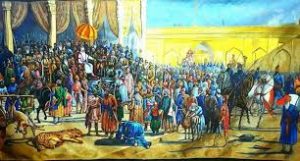
Durbar of Maharaja Ranjit Singh
The Persona of Maharaja Ranjit Singh
Despite being blind in one eye and injured in one arm, Maharaja Ranjit Singh integrated the highly volatile and disparate Sikh Misls and built one of the most glorious of all Empires in history in a short period of time.
He introduced various reforms and welfare measures for the public. Even though he remained unlettered, Punjab became the most literate state of the sub-continent under his rule. His finance minister was a Hindu Brahmin, his Prime Minister was a Dogra, his foreign minister a Muslim. He was so sensitive to the religious beliefs of his subjects that he banned cow-slaughter in this empire. He developed infrastructure and built highways and canals. He reduced the taxes on traders and the poor people.
Maharaja Ranjit Singh is remembered not only as the founder of the Sikh Empire but also as a ruler who patronized Sikh, Hindu and Muslim religious institutions alike. His donations reflected his belief that the ruler’s duty was to protect and support all faiths within his realm.
He undertook massive renovation of old Gurdwaras and shrines which included the rebuilding and beautification of Harmandir Sahib in Amritsar where he covered the upper structure with gold, leading to its popular name, the Golden Temple. He also gave generous grants to Takht Patna Sahib in Bihar and Hazur Sahib at Nanded, Maharashtra.
Ranjit Singh donated large quantities of gold for gilding the Kashi Vishwanath temple’s domes and spires. He made substantial offerings of gold and valuables, including a gold canopy to the Jwalamukhi Temple in Kangra. He provided grants and ensured protection for pilgrims travelling to the Hinglaj Mata Temple. Many more temples in Kangra, Chintpurni and other hill states received land grants, cash donations and protection. He also patronized numerous Muslim shrines and mosques, demonstrating a broad policy of religious accommodation
Apart from being a great warrior and an equally able and wise ruler the Maharaja was, most importantly, a great human being. During his reign Punjab became rich and prosperous. He had retrieved the Kohinoor diamond from Shuja Shah Durrani of Afghanistan and possessed it till his death. Later. Maharaja Duleep Singh handed it over to Queen Victoria.
Maharaja Ranjit Singh is the only King in world history to have conquered and tamed the Afghans. It is a feat which even modern militaries of Russia and USA could not achieve. A great warrior, able and wise ruler, great human being and loved by his people.
The Break-up of the Sikh Empire
The British conquered many states in India and often reinstated the rulers to continue with the administration after paying due tribute to the British Empire. In the case of Punjab, they dispossessed the ruler Maharaja Duleep Singh and did not allow him to get back to his people. This was because of their mortal fear of Punjab and its people who, they felt, could overthrow them at any time if they got the leadership of the family of their beloved leader, Maharaja Ranjit Singh. On the other hand, they allowed many princes in the Punjab to flourish since they were pliant and loyal to the British crown.
The British also realised that keeping Punjab, especially Sikhs on their side was imperative to continue their hold on the Indian land mass. They, therefore, treated Sikhs with utmost respect and gave preferential recruitment to Sikh youth in the British Indian army. This policy helped them control the Afghans and the Russians and also paid invaluable dividends in World War I and World War II.
Finally, the British realized that Punjab and the Sikhs were the only race that would put paid to their mischievous plan to control the sub-continent by creating a pliant state in the form of Pakistan. They, therefore, gave away Lahore, the enduring legacy of Maharaja Ranjit Singh and other significant Sikh institutions like Gurdwara Kartarpur Sahib and Gurdwara Nankana Sahib to the enemy nation Pakistan.
It is unfortunate that the Indian leadership of the time did not see through the evil plan and machinations of the British and agreed to weaken the very region that would have been its enduring strength. Sadly, the lack of understanding of Punjab has been continuing since independence.
Conclusion
The remarkable aspect of Ranjit Singh’s legacy is that he built a powerful empire largely through personal authority and political skill. Unfortunately, he did not establish a stable institutional mechanism for succession. After his death, rival court factions, ambitious nobles, and competing royal claimants plunged the kingdom into instability. Within ten years of his passing, the Sikh Empire had disappeared, making it one of the fastest collapses of a major nineteenth-century state.
Maharaja Ranjit Singh was not only Sher-e-Punjab but indeed Sher-e-Bharat. His legacy needs to form an integral part of Indian history and one that pursued glory instead of conspiracy and defeat. He has to be placed as a motivating icon of the future generation on nationalist Indians.