Dr. Iqbal Singh Lalpura
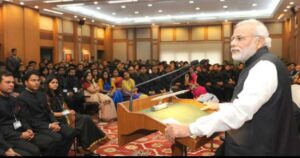
Prime Minister Narendra Modi addressing IAS Probationers
India recently woke up to deeply disturbing news from Punjab. The Central Bureau of Investigation reportedly raided premises connected with officials linked to the Vigilance establishment, while in another case a senior police officer of DIG rank was arrested on allegations of illegal gratification. Public discussions and media reports further suggested that a civilian conduit allegedly named several senior IPS and IAS officers while describing a wider network of corruption and influence. Whether every allegation is ultimately proved or disproved is the responsibility of investigative agencies and courts, but the larger issue before the nation cannot be ignored.
If institutions created to fight corruption themselves come under suspicion, what message reaches the ordinary citizen?
This concern is not limited to Punjab alone. Across India, senior bureaucrats, police officers, and public servants have faced inquiries, arrests, vigilance investigations, and prosecutions. During elections, Chief Secretaries, Directors General of Police, District Magistrates, and other senior officials are frequently transferred or removed on allegations of bias or misuse of authority. Slowly but steadily, public confidence in the neutrality and moral strength of the administrative system appears to be weakening.
India inherited its bureaucratic framework from the British Empire. The Indian Civil Service and Imperial Police were not ordinary government jobs; they were designed as the administrative machinery to govern a vast subcontinent. The British selected only a handful of candidates every year, mostly from the finest universities of England. Their numbers were extremely small, sometimes less than twenty annually. Before being posted to India, they were trained rigorously in administration, law, discipline, conduct, and governance.
Their loyalty was unquestionably to the British Crown and not to India. Yet history also records that the British invested heavily in administrative discipline, supervision, and institutional standards. Officers were expected to be firm, punctual, financially honest, humble in public conduct, and upright in administration. No indiscipline was tolerated. Corruption was treated as a disgrace capable of ending a career permanently.
That is one reason why many older generations still speak of certain aspects of British administration with respect. The system may have been foreign and imperial, but it was often perceived as efficient and predictable. The word of an officer carried authority because people believed that he was unlikely to compromise his conscience for personal benefit.
After Independence, India retained much of this administrative structure. The “steel frame” of governance continued, but its loyalty shifted from the Crown to the Constitution of India. Indian officers took charge of governance and administration. In the early decades after Independence, many civil servants carried forward traditions of discipline, sacrifice, and nation-building. They worked under difficult conditions, managed communal tensions, responded to natural disasters, and helped strengthen a newly independent democracy.
However, with time, the system slowly began changing.
The generation of Indian-origin officers recruited during British rule retired around the late 1970s and early 1980s. Thereafter, a new administrative culture gradually emerged. India expanded economically and politically. Government spending increased massively. Political competition intensified. Alongside growing opportunities came growing temptations.
Today’s civil servants are academically brilliant. Many are doctors, engineers, management graduates, and highly accomplished professionals. The civil services examination remains among the toughest competitive examinations in the world. Lakhs of young Indians compete every year for a few hundred positions because bureaucracy continues to offer power, prestige, influence, and security.
A large majority of officers remain honest and hardworking. Many continue to serve the nation with sincerity under enormous pressure. Yet the concern arises because even a small percentage of corruption at senior levels can deeply damage institutional credibility.
The present crisis is not merely administrative. It is moral.
“Examinations create officers; character creates guardians of democracy.”
Passing a difficult examination proves intelligence, memory, analytical skill, and hard work. But governance requires something greater — integrity, moral courage, humility, and commitment to justice. A nation cannot be governed by qualifications alone.
“A nation is not governed by examinations alone, but by the moral courage of those who pass them.”
The growing concern today is that in many places constitutional courage is being replaced by a culture of convenience and compliance. “Yes Boss” often appears more rewarding than “Yes Constitution.” Instead of advising political leadership honestly and fearlessly, some officers allegedly become instruments for irregular or unlawful decisions. Transfers, contracts, mining, excise, land matters, recruitment, and investigations sometimes become areas where political interests, criminal networks, and corrupt administrative elements intersect.

Money on such a scale rarely emerges from honest activity. Illegal wealth often originates from exploitation of public systems, organised corruption, criminal activity, or misuse of state authority. When corrupt businessmen, criminal elements, compromised officials, and political power begin operating together, the ordinary citizen becomes helpless. Laws are then applied selectively. Honest officers become isolated. Fear replaces fairness.
The danger is not merely to governance but to democracy itself.
Institutions survive on public trust. Citizens may tolerate inefficiency or delays, but once they lose faith in fairness and honesty, frustration turns into cynicism. Democracy then becomes vulnerable to instability and public anger.
The real strength of India’s civil services was never intelligence alone. India has always produced intelligent people. The true strength of the administrative system was character.
An officer with moral courage and a strong backbone can become the finest protector and implementer of government policy. Such an officer may disagree respectfully with unlawful pressure while still loyally implementing legitimate decisions of elected governments. He or she understands that loyalty to the Constitution must remain above loyalty to individuals.
Unfortunately, modern bureaucratic culture often appears to reward networking more than integrity. Officers seen as close to centres of political influence are frequently considered more successful than those who maintain independence. Honest officers sometimes face repeated transfers, isolation, or denial of important responsibilities. This sends a deeply damaging message to younger generations entering public service.
The larger question therefore becomes unavoidable: how foolproof is our present system of selection, verification, training, and supervision?
Can an examination truly measure honesty? Can interviews fully judge moral strength? Can training academies alone create integrity?
Perhaps not.
“Brilliance without ethics is more dangerous than ignorance with power.”
A highly intelligent but morally compromised officer can manipulate systems far more effectively than an ordinary criminal. That is why ethics and accountability become essential pillars of governance.
Training academies do attempt to teach constitutional values, discipline, and professionalism. Yet morality cannot be built only through lectures or textbooks. Ethical conduct develops through institutional culture, leadership examples, transparent accountability, and certainty of punishment for wrongdoing.
There is also a wider social issue involved. Society itself increasingly celebrates wealth and influence without questioning how they were acquired. Expensive lifestyles, visible power, and access to authority often receive admiration, while simplicity and integrity appear less glamorous. In such an environment, moral decline within institutions reflects a broader moral confusion within society itself.
Still, India should not lose hope.
Even today, thousands of officers across the country quietly serve with honesty, courage, and dedication. Some risk their careers to uphold the law. Some fight organised crime and corruption. Some protect the weak during communal tension or political pressure. India continues to stand strong because such officers still exist in large numbers.
But reforms can no longer be delayed.
India must strengthen not only examinations but ethical foundations. Recruitment should continue rewarding merit, but greater attention must also be given to integrity assessment, psychological evaluation, and moral orientation. Honest officers deserve institutional protection and public respect. Internal vigilance systems must function independently and swiftly. Political leadership must recognise that corrupt officers ultimately damage governments more than opposition parties ever can.
Most importantly, society itself must begin respecting integrity more than influence.
The British built an administrative machine to serve an empire. Independent India must build an administrative culture worthy of a civilisation and a democracy. Efficiency without morality creates fear. Power without ethics creates corruption. Intelligence without character creates manipulation.
India does not merely need successful officers. India needs trustworthy officers.
The future of governance will not be decided only in examination halls. It will ultimately be decided in the conscience of those who hold authority.
(The author is former Chairman National Commission for Minorities Government of India – 9780003333)