Jaibans Singh
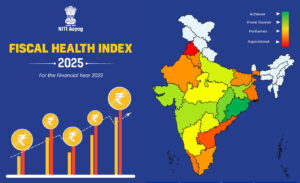
In a major setback Punjab has, once again, gained the ignominy of being placed lowest amongst major states of the nation in the Fiscal Health Index (FHI) – 2025, recently released by NITI Aayog.
Punjab ranks 18th (last), with a composite score of 12.4 out of 100. The nearest state is about 10 points above Punjab while Odisha, the state at the top, is a massive 61 points above Punjab at 73.1, The national average is also two times above Punjab at 37.84.
Once celebrated as India’s most prosperous agrarian state, this ranking presents a stark and troubling picture of Punjab’s public finances.
Calculation of Fiscal Health Index
The FHI is a data-driven framework designed to evaluate the fiscal sustainability of Indian states. It draws upon audited financial data submitted to the Comptroller and Auditor General of India (CAG) and builds a report which is standardised and credible. The index evaluates states across five key pillars:
- Revenue mobilisation which calculates the ability to generate tax and non-tax revenues within the state.
- Debt index, by far the most significant input, indicates whether the state is functioning within its means or and not.
- Debt sustainability factors the ability of the state to service debt. The parameters are with ease, with stress and finally moving towards a debt trap.
- Quality of expenditure focuses mainly on the resources utilised for capital and developmental spending
- Fiscal prudence is basically a bureaucratic exercise conducted with political support to keep the fiscal deficit and revenue deficit in control.
The basic idea is to assess whether a state is living within its means while investing adequately for future growth. The index thus moves beyond simple deficit figures to examine the composition and sustainability of finances.
Sadly, Punjab’s placement in the bottom of the ladder is the fallout of a serious weakness in all the parameters that are adopted for the assessment. The most critical parameter by far is the rising debt burden.
Punjab’s Weak Performance
At the turn of the millennium, Punjab was among India’s richest states. Its fiscal system benefited from procurement-driven agriculture, central subsidies, and a robust rural economy.
In the first decade of the millennium, structural stagnation set in. Punjab began accumulating revenue deficits due to excessive borrowing to meet day-to-day expenses. Fiscal stress witnessed considerable acceleration from 2022 onwards mainly due to an unprecedented expansion of freebies and subsidies in an eco-system of weak tax buoyancy.
While freebies are free flowing, economic expansion is in the negative zone. The overall effect has been a continuous erosion of the fiscal performance of successive governments.
Debt index and sustainability – Punjab’s most critical situation is its debt index and debt sustainability. The outstanding debt of the state was approximately ₹45,000 crores in the early 2000s. This increased to about ₹83,099 crores in 2011-12 and soared to over ₹2.61 lakh crores by 2020-21, with an average annual growth rate of 14.63 percent.
Under the aegis of the incumbent Aam Aadmi Party (AAP) government the debt has soared to an alarming ₹4.17 lakh crore. According to the Punjab Budget, 2026-27, the debt is projected to rise to ₹4.43 lakh crore, which is the liability that the next government of the state will have to contend with. This would imply that the debt is projected to reach 44 to 47 percent of the GSDP, well above the recommended limits of the Fiscal Responsibility and Budget Management (FRBM) Act, 2003.
Low revenue mobilisation – Development can be sustained only if revenue is commensurate to the goals set by the government. In Punjab, over the last few decades, the state has very low revenue mobilisation. Agriculture, the mainstay of Punjab, has not witnessed any diversification from the debilitating wheat-rice cycle and, as a result, it has plateaued.
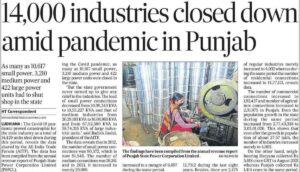
Ludhiana was once called the “Manchester of the East” because of its industrial production of bicycles, hosiery, and auto parts. Jalandhar was famous for sports manufacturing and Batala was good for machine tools etc. Overall, the state boasted of a huge MSME manufacturing base. Sadly, the state has witnessed a significant flight of industry over the past two decades to the benefit of neighbouring state and even far off states like Uttar Pradesh and Gujarat.
The reasons are very obvious, high power tariffs, limited excise duty exemptions, high cost of land, frequent disruption by agitating groups (mainly farmers) and, most of all, deeply embedded corruption and extortion.
Let us translate the aforementioned statements into data through comparison with two states – neighbouring Haryana and the national industrial hub Gujarat.
In Haryana, contribution of the non-agriculture sector is about 15 percent more than Punjab; it has a focus on heavy industry and IT while Punjab is more dependent on MSME. As a result, GST collection in Haryana in the financial year 2025 was ₹1,19,362 crores with per capita income at ₹3,25,759; in Punjab GST collection was ₹23,642 crore and per capita income at ₹1,95,621. Haryana is way ahead of Punjab.
Let us compare industry in Punjab and Gujarat. Prime industrial land in Gujarat in the form of extensive industrial estates/SEZs is ₹15 lakhs to ₹3.5 crores per acre. In Punjab we have limited land in focal points that goes for upward of ₹30 lakhs to ₹5 crores per acre (almost double the rates of Gujarat). Guaranteed power is sold in Gujarat at ₹3.65 per unit and in Punjab at approx. ₹5.25 to ₹6.5 per unit with frequent power cuts (again almost double).
In the backdrop of the above data it does not take rocket science to understand the disinclination of investors to come to Punjab.
High committed expenditure – Punjab has the lowest rate in the collection of domestic tax revenue. It relies heavily on financial support from the centre. Yet, the opposition led state government remains constantly at loggerheads with the centre and, as a result, what comes or can come is also not optimally utilised/leveraged due to blinkered political policies.
Most of the revenue goes on interest payment and the remainder meets salary and pension liabilities. Add to this the subsidy culture and there is nothing left for capital expenditure. Reports indicate that committed expenditure consumes nearly 75–80% of revenue receipts, leaving little fiscal space for development.
Successive state governments, including and most of all the present government, have been giving assurances of a reversal of the trend but it is not visible on ground.
The Odisha Model
Odisha, once one of the most backward states, decided that borrowing is an unsustainable practice. Over decades it has adopted a strict fiscal policy that is based on controlling deficits and working statistically towards improving revenue mobilisation. It has invested heavily in governance reforms and has put in place a steady build-up of infrastructure. It is these factors that now place the state at the top of the FHI.
The Way-ahead for Punjab
Punjab can bounce back by taking some firm steps. In the short term of 1–3 years, it has to make a concerted effort towards stabilisation. This would include a rationalisation of its expenditure mainly with a cap on non-merit subsidies. Welfare would still be possible if the central schemes are effectively implemented. Tax compliance and GST collection has to be enforced by proper digitisation of revenue systems and due vigilance. There has to be strict adherence to FRBM targets and public disclosure of liabilities
In the medium term of 3 to 7 years, focus will need to remain on structural correction and diversification of the economy. Industries that suit Punjab need to be identified and set-up. A bigger boost to the MSME base along with development of agro-processing industries and IT may pay great dividends. By any and every means, the focus on capital expenditure has to increase, only then will productivity improve. The power sector needs urgent reforms including rationalisation of free power.
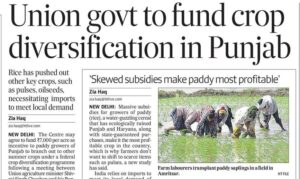
In the long term of 7 to 15 years, the state has to adopt a sustainable growth model with agricultural transformation acting as the pivot. There is an urgent need to get rid of the wheat–paddy cycle in favour of high-value crops. Attention needs to be paid to investment in human capital with improvement in education and skill development and a build-up of the services-driven economy.
Conclusion
The FHI is not just a ranking, it reflects deep structural weaknesses and is a warning signal of a systemic imbalance. It also opens an opportunity for Punjab to reset its fiscal trajectory before it is too late. There is a need to get out of the policy inertia, and fiscal populism that has created the existing terrible situation.
The decline is not irreversible. It can be easily reversed by awakening the traditional spirit of the Punjab people. The people have to be made a party to the reform process. The political party that sheds the populist route and requests for the people’s participation in ushering Punjab to its lost glory will find maximum support from the people.