Jaibans Singh
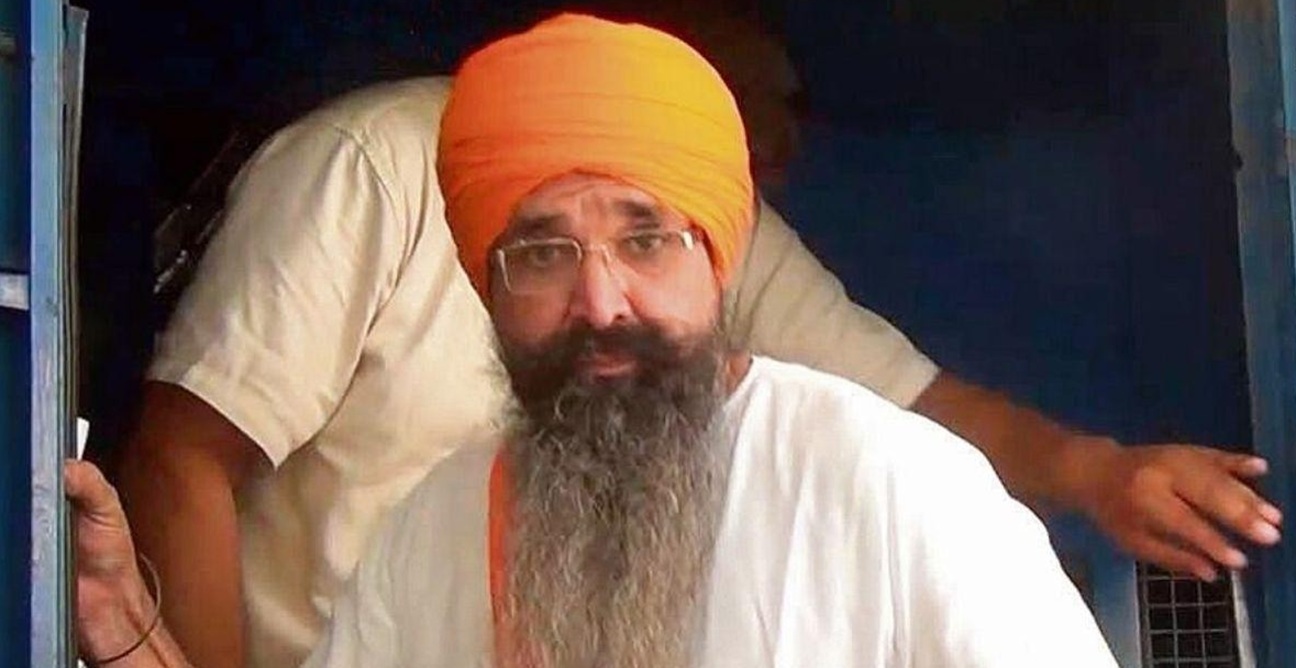
Balwant Singh Rajoana
During a Supreme Court hearing on 7 October 2026 concerning Balwant Singh Rajoana, one of the accused in the 1995 assassination of former Punjab Chief Minister Beant Singh, the Union government opposed his plea for commutation of his death sentence to life imprisonment. Representing the government, Additional Solicitor General KM Nataraj argued that the prevailing situation in Punjab was not conducive to taking a decision in favour of commutation. “We have objections to what they are demanding. Considering the prevailing situation in the state (Punjab), it will not be conducive to take any decision,” he told the court. The Union Ministry of Home Affairs (MHA) has been holding this position since 2022. In its arguments it describes Punjab as border-state status and also emphasises upon its history of terrorism as relevant considerations.
The government also made a plea that the appeals of Rajoana’s co-accused were pending and their outcome could have a bearing on deciding his case. Further, to substantiate its case, the government has taken a position that Rajoana’s conduct did not warrant mercy, in view of his stated lack of faith in the judicial process and lack of remorse for the crime.
Finally, in the hearing on 7 October 2026, the Supreme Court bench comprising Justices Vikram Nath, Sandeep Mehta and Aparesh Kumar Singh has ruled that the bench will hear the case on merits. “Now that they (the accused) insist on commuting their death sentence to life, which you (the union government) oppose, we will hear the matter on merits,” the bench said. The counsel for the Union government has sought time to prepare the case. The court has set 28 October 2026 as the date for the next hearing.
The Background
Balwant Singh Rajoana, a former Punjab Police constable, was arrested along with his accomplices for involvement in a suicide bombing outside the Punjab Civil Secretariat in Chandigarh on August 31, 1995 that killed Beant Singh, then chief minister of Punjab and 16 others. Rajoana was identified as the backup bomber.
A trial court pertaining to the assassination was convened and presided over by a special Judge, Ravi Kumar Sondhi. The trial was conducted in a makeshift courtroom located within the high-security Burail Jail in Chandigarh.
Rajoana confessed that he had personally strapped the explosives on Dilawar Singh, the designated suicide bomber who ultimately died in the blast, while he himself was a stand-by bomber. He further stated that he held no personal hostility against Beant Singh but carried out the assassination because the latter had killed thousands of innocent people. He also spoke about Operation Blue Star and the anti-Sikh violence of 1984 and alleged that Punjab Police and intelligence agencies had been given a free hand to kill Sikh youth. He portrayed the assassination as retaliation for what he regarded as state atrocities against Sikhs.
The trial court convicted the accused on 27 July, 2007. Rajoana was convicted for criminal conspiracy, murder, attempt to murder and offences under the Explosives Substances Act. The quantum of sentence pronounced on 1 August, 2007 included death sentences for Balwant Singh Rajoana and Jagtar Singh Hawara while others involved in the conspiracy were awarded imprisonment.
Hawara challenged his conviction and sentence in the High Court. In its judgment of 12 October 2010, the Court upheld his conviction but commuted his death sentence to life imprisonment. Rajoana, however, refused to appeal against his death sentence. The High Court upheld his conviction and death sentence.
Rajoana was scheduled for execution on March 31, 2012. The execution, however, was stayed following a mercy plea filed by the Shiromani Gurdwara Parbandhak Committee (SGPC) on his behalf under Article 72 the Constitution which empowers the President to grant pardons, reprieves, respites or remissions of punishment, and to suspend, remit or commute a sentence of death. It is well documented that neither Rajoana nor any member of his family petitioned for mercy. The government, nevertheless, stayed the execution. Till date, successive governments have failed to send forward a final recommendation for acceptance or rejection of his mercy plea to the President. Rajoana remained on death row.
On 27 September 2019, on the recommendation of its then alliance partner, the Shiromani Akali Dal, the MHA wrote to the Punjab Government to process a proposal for commutation of Rajoana’s death sentence to life imprisonment under Article 72 of the Constitution. The proposal, however, was not formalised, in the meantime, the BJP-SAD alliance broke.
When the process of commutation of the sentence was delayed/deferred by the Union government, Rajoana moved the Supreme Court, in 2020, to challenge the delay. It is at this point in time that the Union government and the Central Bureau of Investigation (CBI) opposed his release. A 2023 Supreme Court judgment did not treat the delay as an automatic ground for commutation, partly because of the Centre’s security-related position.
Rajoana then filed a fresh writ petition, registered as W.P. (Criminal) No. 414/2024 arguing that he was entitled to remission because no decision had been taken on the mercy plea for years on end. He held that the situation violated his right to life under Article 21 of the Constitution. On May 3, 2024, the top court disposed of the plea, noting that the MHA’s decision to defer Rajoana’s mercy petition on the ground of national security and the law and order “actually amounts to a decision declining to grant the same for the present.”
In January 2025, the Supreme Court gave the Centre an opportunity to take a decision, warning that otherwise it would consider the matter itself. Yet, the issue continued to be deferred. In September 2025, the Court questioned as to why Rajoana had not been executed if the death sentence was being maintained. The statements of the Hon’ble Judges indicate that they are becoming increasingly impatient with the delaying posture being adopted by the Union Government.
On 23 September 2026, Rajoana’s senior counsel told the Supreme Court that he was pressing the petition specifically for commutation of the death sentence to life imprisonment. As mentioned above, the next hearing on the matter is scheduled for 28 October 2026
Rajoana, however, continues to remain reluctant to accept mercy in the conventional sense. In 2025, on his insistence, the SGPC said it would consult the Sikh community about withdrawing its petition. In 2026, Rajoana again asked the SGPC and the Akal Takht to have the petition withdrawn. The institutions, however, have not withdrawn the mercy petition till date and it continues to remain active.
It is evident that Rajoana actually wants the government to execute his death sentence even though his present legal proceedings have brought commutation directly before the Court.
A summary of the time-line is as follows: –
- 1995: Rajoana and his associates assassinate Beant Singh in Chandigarh.
- 2007: The Trial court convicts those involved in the Beant Singh assassination case. Rajoana is awarded a death sentence against which he does not appeal.
- 2010: Punjab and Haryana High Court confirms and upholds death sentence.
- 2012: Rajoana is scheduled for execution on 31, March; SGPC submits mercy petition to President of India; the Government stays the execution; Rajoana stays on death row.
- 2019: Centre proposes commutation of death sentence to life imprisonment. The proposal, however, is not formalised.
- 2020: Rajoana challenges delay in decision of his case in the Supreme Court.
- 2023: The Supreme Court declines to commute the death sentence and leaves the matter to the competent authority
- 2024: Rajoana files a fresh writ petition, arguing that he was entitled to remission because no decision had been taken on the mercy plea for years
- 2025: Supreme Court questions why he has not been executed
- 2026: Centre now actively opposes commutation
As things stand now, the death sentence remains on the books, the mercy petition remains unresolved, and the prisoner continues to live in a debilitating situation of uncertainty. The Indian judicial system first took 17 years to confirm a death sentence to an accused in a high profile assassination case and fix a date for his hanging despite the accused having admitted to his role in the assassination and accepted the award of death sentence meted out to him. Against all legal practices, a mercy petition filed by a different institution on his behalf led to a stay on the execution. For 14 years after that the stay has not been revoked as governments of different parties play with his life and dignity in the Court, allowing him neither death nor commutation of the sentence.
The Aspect of Human Rights
Rajoana was kept in Burail Central Jail, Chandigarh, from 13 July 2007 until 14 January 2010. Section 30 (2) of the Prisons Act, 1894 provides that a prisoner under sentence of death is to be confined in a cell away from other prisoners and kept under guard day and night. In his petition to the Supreme Court in 2020, Rajoana specifically states that for about two and a half years he was kept in “solitary confinement” for 22 hours every day in Burail Jail.
An Indian Express report of April 2012 gave a detailed breakdown of what such solitary confinement entails. The condemned prisoner is kept in a condemned/death cell under round-the-clock supervision by jail warders, including while sleeping. His/her food is prepared separately and checked before being served. He is not permitted to interact with anybody or receive family members without permission.
The Supreme Court has adjudicated on the aspect of solitary confinement in two cases. In Sunil Batra v. Delhi Administration (1978), the Court held that Section 30 (2) of the Prisons Act does not empower prison authorities to impose solitary confinement on a condemned prisoner. In Shatrughan Chauhan v. Union of India (2014) the Court went further to say that solitary confinement of death-row prisoners can constitute a violation of Articles 14, 19 and 21, and specifically recognised prolonged solitary confinement as a circumstance relevant to commutation of a death sentence. The Court specifically said that authorities have a duty to deal with mercy petitions expeditiously, although no rigid universal time limit can be prescribed. It has remarked that remaining in a condemned cell for years due to inordinate and unreasonable delay in executing a death sentence can amount to torture and violate Article 21 of the Constitution.
Rajoana was moved from Burail to Patiala Central Jail in January 2010. In April 2012, following the intervention of the Punjab and Haryana High Court and the pending mercy petition, the Punjab prison authorities expressly ordered that he be taken out of solitary confinement. However, in 2022, The Times of India reported that he had spent years in an 8 × 8-foot cell in the Phansi-Chakki (death-row section) at Patiala. More significantly, in December 2023, when he began a hunger strike, Rajoana himself described his situation as 17 years in a solitary barrack. And in July 2026 he reportedly wrote that he was completing 19 years in Phansi-Chakki.
There are, however, indications that his life is not entirely devoid of normal prison interaction. There have been meetings with family, friends and well-wishers. He was granted parole for an hour in January 2022 to attend the last rites of his adoptive father, and in November 2024 for three hours’ to attend the Bhog ceremony of his brother. There have also been visits by Sikh religious leaders.
These facilities, by no means, mitigate the extreme psychological stress that he has been enduring for a prolonged period of time due to an inability of the government in deciding his fate.
Concluding Remarks
There is a very strong Article 21 argument that prolonged, unexplained executive delay in a death case can be looked upon as cruel and unconstitutional treatment by the state. The Supreme Court has recognised that the psychological suffering caused by prolonged uncertainty over execution is constitutionally relevant.
The government has now stated its substantive position of contesting the plea by Rajoana for commutation of his death sentence to life imprisonment. The Court can therefore ask the obvious question: if the executive has decided that commutation is inappropriate, why has it not completed the Article 72 process and allowed the President to decide the mercy petition?
The Supreme Court is not confined to deciding whether the original mercy petition was personally initiated by the prisoner. It can examine whether the prolonged delay in carrying out a death sentence warrants commutation under the applicable precedents. Once executive delay becomes prolonged, unexplained or disproportionate, Article 21 gives the Supreme Court constitutional authority to intervene. The Court has, so far, stopped short of automatically commuting Rajoana’s sentence partly because of the peculiar procedural and security circumstances surrounding his case.
Should the State keep a person under a death sentence for nearly two decades after the judicial process has substantially concluded? If the answer is “no” then the state has an option to execute the sentence, since all constitutional and legal requirements for execution have been completed or commute the death sentence, leaving the prisoner to serve the custodial sentence as laid down by the law. What it should not do is to indefinitely avoid consideration of the mercy petition. A death sentence is a punishment; prolonged, unexplained uncertainty about whether that punishment will ever be carried out can become an additional punishment.
In September 2026, Rajoana wrote to the Prime Minister asking for a final decision on the mercy petition or execution of the death sentence. He said that the prolonged uncertainty had become worse than the death sentence itself. It would be befitting for the prime minister’s office to respond to his plea.
The Final Word
Balwant Singh Rajoana committed an act that is looked upon as a crime by the judicial system of the country. He admitted to his role and accepted the death sentence awarded to him. Throughout the years that followed, he has conducted himself with dignity and composure, seeking neither sympathy nor personal favours.
Whatever may be one’s view of his crime or the punishment it deserves, the question that now confronts the nation is whether a state governed by the rule of law can justify keeping a human being suspended in uncertainty for nearly two decades after a judicial sentence has been pronounced. An enlightened democracy cannot allow an individual to become hostage to administrative indecision and political calculations.
If the State apprehends a threat to public order arising from the execution of the sentence, it is incumbent upon it to devise lawful and effective measures to address the concern. The possibility of a security challenge cannot, by itself, become a perpetual justification for leaving a matter of life and death unresolved.
Rajoana submitted himself to the law of the land. The State, in turn, owes him the assurance that the law will be administered with fairness, consistency and humanity. Justice must not only be done; it must also be seen to be done. Let the law prevail, and let the uncertainty end.